Every living room can be cozy. The question is not whether your room has the right bones, size or budget. It is whether you know what cozy living room ideas actually rely on, and in what order to use them. This guide covers lighting, textiles, materials, layout and budget for any style, with prices given as ranges so you can plan realistically.
The five elements of a cozy living room
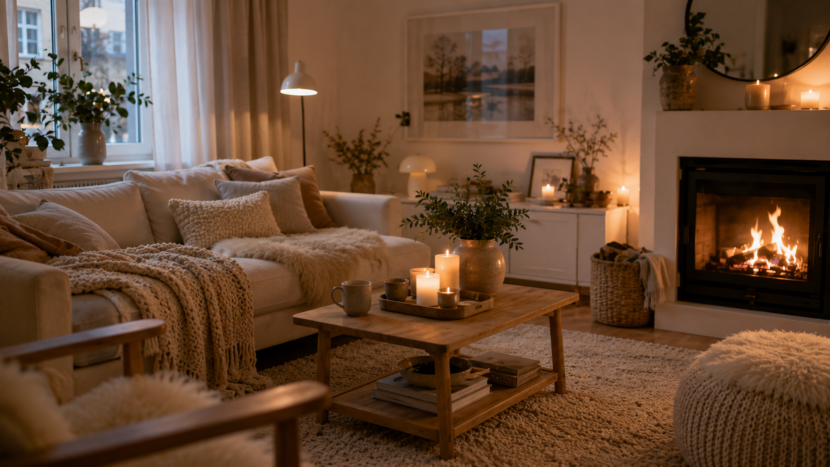
Every cozy living room shares five things: layered lighting, soft textiles, natural materials, something alive, and a few personal objects that tell a story. You do not need all five at once. Adding the two or three your room currently lacks will change it more than any single big purchase.
Cozy is a feeling of warmth and safety without crowding. The light is low and soft, the surfaces invite touch, and there is enough to look at that the room feels lived in but not so much that your eyes never rest. Most living rooms that feel cold are not missing furniture. They are missing light at the right height, texture on the sofa, and a few things that look chosen rather than bought as a set.
Layered lighting comes first
If your living room depends on one ceiling fixture, it will not feel cozy, whatever else you add. Overhead light is flat and throws shadows in the wrong places. Build three levels instead: a floor lamp for general evening light, a table lamp near the seating for a pool of warm light, and candles or a small shelf light for the lowest, most atmospheric layer.
Check the bulb box for color temperature. 2700K is warm and slightly golden, 3000K is a little crisper, and anything at 4000K or above reads like an office. Look for roughly 800 lumens per lamp. The U.S. Department of Energy’s guide to LED lighting explains how to read lumens and Kelvin. A floor lamp usually costs about $30 to $80 and a table lamp $15 to $40, and secondhand shops often have both for less. For more, read our guide to cozy living room lighting for a warm atmosphere.
Textiles: the throw, the cushions and the rug
A throw blanket draped over one arm of the sofa is the strongest cozy signal in any living room. It says this is a place you are allowed to relax, it gives real warmth on cool evenings, and it adds color and texture without new upholstery. Choose one heavy chunky knit, wool blend or fleece throw, roughly $20 to $60, rather than several thin ones that slide off.
Cushions do the second job. Buy covers instead of whole cushions, around $8 to $25 each, and mix two or three textures in one color family: boucle, linen, velvet, cable knit. A pattern is optional. Variety in surface matters more than variety in color. Keep the count to three or four on a sofa, or the seat becomes unusable.
The rug anchors everything. Aim for one large enough that at least the front legs of the sofa and chairs sit on it. A 5 by 8 foot rug is roughly $60 to $200 depending on material, and a low-pile washable one is the practical pick if you have pets or children. Layering a smaller sheepskin or runner on top adds depth for a few extra dollars.
Natural materials and something alive
Wood, rattan, wool, linen, stone and ceramic make a room feel grounded in a way that glossy plastic and chrome rarely do. You do not need to replace furniture. A wooden bowl on the coffee table, a woven basket for blankets, a ceramic lamp base, or a linen lampshade is enough to shift the balance.
Add something alive. A pothos, snake plant or ZZ plant tolerates low light and costs about $10 to $25. A bunch of grocery-store stems in a jar, or a branch in a floor vase, brings an irregular shape into a room made of straight lines. If plants never survive for you, one large faux stem looks better than several small ones.
Books and personal objects
A living room with visible books looks lived-in and warm in a way few other things achieve. You do not need a library. A stack on the coffee table, a short row on a shelf with the spines visible, and a few photographs or small objects from travel are enough. Thrift stores often sell hardbacks for $1 to $3, and they double as risers for a lamp or a plant.
Group objects in odd numbers and vary the height. Leave some empty space around each group. Cozy is not the same as cluttered, and a surface with three considered items feels warmer than one with ten.
Cozy living rooms in every style
The principles carry across every look. Only the route changes.
A minimalist living room gets there through proportion, one exceptional textile and warm light rather than many objects. Our piece on modern minimalist decor that actually feels warm shows how. A boho room layers rugs, plants and collected objects, and boho living room ideas that feel warm, not overwhelming keeps that from tipping into chaos. A Scandinavian room relies on pale wood, sheepskin and candlelight, which is the hygge approach covered in hygge living room ideas. A warm neutral palette works for almost any of them, and warm neutral living room ideas on a budget lays out the colors.
What to buy at every budget
Spend in the order that changes the room most per dollar.
Under $25. Swap every bulb for 2700K, move one existing lamp to the darkest corner, put a throw you already own over the sofa arm, and clear the coffee table down to a tray and a candle. Two cushion covers fit here too.
About $25 to $100. Add one heavy throw, a second lamp, a woven basket for blankets and a plant. Hang lined curtains close to the ceiling and wider than the window, which makes the room look taller. Our guide to curtain ideas for small rooms shows how.
About $100 to $300. Buy the rug, a proper floor lamp and a small side table. These are the pieces that carry the room for years, so it is worth waiting for a sale or checking secondhand listings first.
If you are renting, check living room decor ideas for renters on a budget before you buy anything that needs fixings. Prices vary by retailer and season, so treat every figure here as a range.
Arrange the seating so people face each other
A sofa pushed flat against the wall with a TV opposite feels like a waiting room. Pull seating into a loose group so people can talk, even if that means the sofa floats a foot or two from the wall. Angle one armchair toward the sofa and place a side table within arm’s reach of every seat. Leave about 18 inches between sofa and coffee table, enough to walk through and still reach a mug.
Put a lamp or a candle within each person’s view, and avoid leaving a dark corner behind the seating. Dark corners make a room feel smaller and colder than it is.
Mistakes that keep a room cold
The common ones are a single overhead light, a matching furniture set bought in one go, bare windows, a rug too small for the seating, and too many tiny ornaments. Cool white bulbs undo everything else. Fix those before you buy anything new, and the room will often feel cozy without a single new purchase. For more finished examples, browse cozy living room ideas that make you never want to leave and our cozy home decor ideas under $50.
Frequently asked questions
How do I make a living room cozy on a tight budget?
Start with bulbs at 2700K, then add one lamp, one heavy throw and two cushion covers. That usually costs under $60 and changes the feel of the room more than new furniture would. Clear the coffee table and add a basket for blankets before you buy anything else.
What colors make a living room feel cozy?
Warm neutrals do most of the work: cream, oatmeal, clay, terracotta, olive and deep green. Choose a base of two or three related tones, then vary texture instead of adding more colors. Avoid stark cool whites and gray-blues if warmth is the goal, since they read as cooler even in good light.
How many lamps does a cozy living room need?
Plan on at least three light sources at different heights, such as a floor lamp, a table lamp and candles or a shelf light. Larger rooms over about 150 square feet often need a fourth. The goal is overlapping pools of warm light so no part of the room depends on the ceiling fixture.
Can a small living room still feel cozy?
Yes. Small rooms are often easier to make cozy because there is less space to fill. Use a smaller rug that still reaches the seating, hang curtains high and wide, and keep surfaces clear. Layered lighting and one or two chunky textiles matter more than extra furniture.