You can make a room feel warmer for well under $50, and the changes that cost the least are usually the ones that work hardest. Swapping the bulbs for warm ones, turning off the ceiling light, adding one heavy throw and clearing the flat surfaces will change how a room feels more than a $300 chair will. Here is what to buy first, roughly what it costs, and what to leave on the shelf.
Start with the light
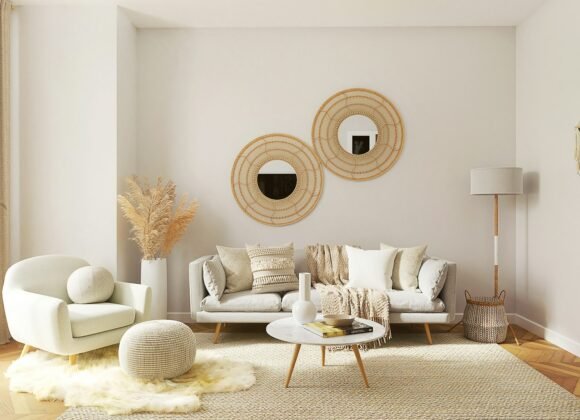
Cozy is mostly a lighting problem. One fixture in the middle of a ceiling throws flat light across everything at once and puts shadows in all the wrong places. Two or three low light sources at different heights do the opposite: they pool light in corners and leave the rest of the room softer.
The number to look for on a bulb box is the color temperature in Kelvin. 2700K reads warm and slightly yellow, close to the old incandescent bulbs. 3000K is a little crisper and still fine. Anything at 4000K or above is the light you get in an office or a supermarket, and no amount of throw blankets will fix it. Packaging often uses words instead of numbers, so “soft white” is what you want and “daylight” is what you don’t.
Prices move around by retailer and season, so treat these as ranges rather than quotes. A four pack of warm LED bulbs runs about $8 to $15. A small table lamp is roughly $15 to $30 at IKEA, Target or Walmart, and often less than that secondhand. A clip-on light for a shelf or a headboard is usually under $15. A plug-in cord dimmer costs around $10 to $15 and lets you drop the brightness in the evening without touching the wiring.
Buy in that order. Bulbs go into fixtures you already own, so they cost the least and change the most. Then add one lamp to whichever corner of the room currently has no light source at all. The U.S. Department of Energy’s guide to LED lighting explains lumens and color temperature if you want the full picture. If you want more on this, the cozy living room lighting guide goes through layering in more detail.
Candles and string lights are the cheap end of the same idea. A string of warm white lights along a shelf or behind a headboard is $10 to $20 and gives you a low light level that no lamp quite matches.
Textiles do the work furniture can’t
Soft surfaces absorb sound as well as light, which is a large part of why a room with a rug and curtains feels calmer than the same room empty. It is also the fastest place to spend $30 well.
- A chunky knit or fleece throw, about $15 to $35. One heavy one is better than three thin ones, because thin throws never stay where you put them.
- Two cushion covers, roughly $8 to $20 each. Buy covers and reuse the inserts you already have. Inserts are the expensive part and nobody sees them.
- A washable accent rug around 2 by 3 or 3 by 5 feet, about $20 to $45. A small rug by the bed or under a coffee table is enough to change the acoustics of a room.
- Curtain panels, roughly $15 to $30 each. Hang the rod wider than the window and as close to the ceiling as the wall allows. The window reads taller and the room looks finished rather than furnished.
Texture matters more than color at this price. Waffle weave, boucle, chunky knit and washed linen all catch light unevenly, and that unevenness is what makes a room of neutrals look layered instead of bare. Three smooth polyester cushions in three different colors will still look flat.
Fix the surfaces you already have
Most rooms that feel uncomfortable are not underdecorated. They have too much loose stuff sitting out on flat surfaces, and no amount of new decor covers that up.
- A woven basket, $15 to $30, holds blankets, chargers, laundry or whatever currently lives on the floor.
- A tray for the coffee table or dresser, $10 to $25, gathers the remote, the coasters and the candle into one shape instead of four.
- Secondhand hardbacks, often $1 to $3 each at a thrift store, give you height to set a lamp or a plant on and fill shelves that look thin.
- A mirror placed beside or across from a window pushes daylight further into the room. Thrifted mirrors run $10 to $40 and the frame takes paint well.
Thrifting is where the budget stretches furthest on anything solid, and thrift store decor flips covers what is worth carrying home and what to leave.
Scent
Scent is the one element people notice within a second of walking in and almost never plan for. A soy candle is $10 to $20 and a reed diffuser $12 to $25, and the diffuser is the better buy for a room you are not sitting in, since it works unattended. Warm, dry scents suit fall and winter rooms better than fruit or florals: cedar, vanilla, clove, tobacco, woodsmoke. Skip plug-in air fresheners, which read as artificial at close range.
One plant, chosen for the room you have
A living plant brings in an irregular shape, which a room made of straight lines is usually missing. Match it to the light you have rather than the plant you like. Pothos, snake plants and ZZ plants all tolerate a dim corner and cost about $10 to $25 in a six inch pot. Ferns and fiddle leaf figs will not forgive a north-facing apartment.
If plants do not survive in your care, go large with a faux one rather than small. A tall stem or branch in a floor vase, around $20 to $40, holds up from across a room. Small artificial plants on a shelf give themselves away from two feet.
Walls without a deposit loss
Paint is the biggest cheap transformation, but in a rental it can cost you the deposit. Ask first. Many landlords agree to a neutral color if you repaint before you leave, and a single sample pot, roughly $5 to $15, is enough to test a shade on a patch beside the window. Warm whites, greige and soft clay tones make a room feel enclosed in a good way. A cool, bright white does the opposite and shows every shadow.
If painting is off the table, change what sits on the wall instead. A length of linen or a fabric wall hanging on a tension rod, about $15 to $30, covers a bare wall without a single nail. Lightweight frames hold on adhesive strips rated for their weight, around $6 to $10 a pack, and come off cleanly if you pull the tab slowly and parallel to the wall. Better still, lean a large mirror or framed print on a dresser or shelf. Leaning art looks relaxed and deliberate at once, and it moves with you.
Keep the first wall to one focal spot, usually behind the sofa or the bed, rather than scattering small pieces everywhere. Our guide to rental-friendly decor that causes zero damage and the piece on removable wallpaper ideas for rentals go deeper on what holds up and what peels.
Bedroom tweaks that fit the same budget
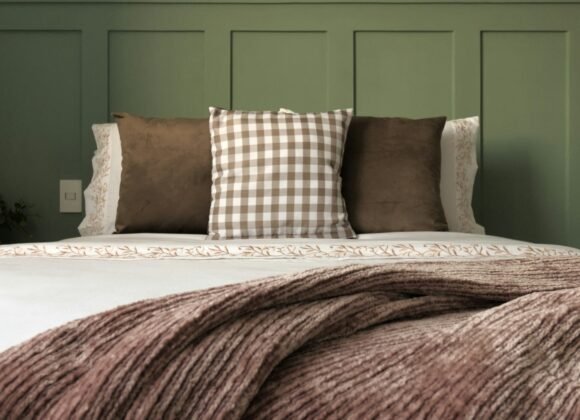
The bedroom follows the same rules with one addition: it should be the darkest, softest room in the home at night. Use bulbs at 2700K or lower in the bedside lamps, and consider a 2200K amber bulb for the last hour before sleep. Put a washable rug where your feet land in the morning, fold a quilt across the foot of the bed, and swap crisp white pillowcases for washed linen or cotton in a muted tone.
Lined or blackout curtains, roughly $20 to $40 per panel, are the one item worth stretching slightly past $50 for if streetlight reaches the bed. For a fuller plan, see cozy bedroom ideas for deep sleep and slow mornings.
Seasonal swaps keep spending low
Cozy changes with the weather, and the cheapest way to keep a room fresh is to rotate rather than add. In fall and winter, put the light cotton throw in a drawer and bring out wool or fleece. Switch cushion covers to rust, olive, oatmeal or deep green, and add pinecones, dried stems or branches from outside, which cost nothing. In spring, store the heavy textiles, open curtains to full width and put fresh stems in a jar.
Covers and throws fold flat, so a whole season of swaps fits in one under-bed box. That habit keeps the budget small because you own fewer things and use each one longer. Our fall decor ideas for an apartment and warm living room ideas for fall and winter cover the seasonal side in more detail.
Three $50 plans, room by room
| Room | What to buy | Rough total |
|---|---|---|
| Living room | Four warm bulbs, one secondhand table lamp, one heavy throw | $40 to $50 |
| Bedroom | Two clip-on lights, two cushion covers, a small rug beside the bed | $45 to $50 |
| Entry or hallway | Thrifted mirror, woven basket, warm bulb for the existing fixture | $30 to $50 |
If you are furnishing more than one room on a tight budget, budget home decor ideas that look high-end is the wider version of this, and the Amazon finds under $50 roundup covers specific products if you would rather shop from a list.
What to skip
- Matching decor sold as a bundle. Everything arrives in the same finish and the room looks staged rather than collected.
- Small ornaments under about $5. They add objects to dust without changing how the room feels, and clutter is the thing you are trying to reduce.
- Peel-and-stick tiles or wallpaper on a textured or freshly painted wall. It lifts at the edges within weeks.
- Very cheap sheer curtains used alone. They filter light in a thin, cold way. Layer them with something heavier or skip them.
The order to do it in
- Swap every bulb in the room for 2700K, then stop using the overhead light in the evening.
- Put one lamp in the darkest corner.
- Clear the surfaces into a basket and a tray.
- Add one heavy throw and two cushion covers.
- Add a rug where you stand or sit most.
- Add one plant and one scent.
Done in that sequence, most people run out of things worth buying before they run out of the $50.
Frequently asked questions
What is the cheapest single change that makes a room feel cozier?
Change the bulbs to 2700K and stop using the ceiling light after dark. If you already own a lamp, the whole thing costs under $10 and takes about five minutes.
Can you do this in a rental without drilling?
Yes. Bulbs, plug-in lamps, rugs, baskets, trays and freestanding mirrors all need no fixings. Tension rods handle curtains in most window recesses. Leaning a mirror against the wall works as long as the base sits on something with grip.
How many lamps does one room need?
Two at a minimum in a living room, and three once the room is over roughly 150 square feet. Put them at different heights so the light is not all landing at the same level.
Do warm bulbs make a room look dim and yellow?
Only if you also drop the brightness too far. Color temperature and brightness are separate numbers. Look for around 800 lumens per bulb, which is roughly what an old 60 watt incandescent gave, at 2700K. That combination is warm without being murky.