Most laundry room ideas assume you have a laundry room. Plenty of us have a closet behind bifold doors, a corner of the kitchen, or a machine tucked under a counter, and the ideas that work there are about storage, surfaces, and hiding the machines rather than cabinetry and tile. This guide covers both: what to do with a dedicated room, and what to do when laundry lives in four square feet of a hallway.
Start with the space you have
Before buying anything, measure three things: the width of the opening, the depth from the back wall to the front of the machines, and the height available above them. Machine depth is the number people forget. A washer that fits the width can still stick out past a closet door once the hoses are connected behind it, and hoses need a few inches of clearance to avoid kinking.
Then decide what the space has to do beyond washing. Sorting, folding, hanging wet clothes, and storing detergent are separate jobs, and a small space rarely does all four well. Pick the two that cause you the most trouble and design around those. If you fold on the bed anyway, you do not need a folding counter. If wet laundry ends up draped over chairs, hanging space matters more than a pretty shelf.
Laundry closet ideas
A laundry closet has one advantage worth using: doors. Everything can look utilitarian as long as it closes.
- Put a shelf directly above the machines, high enough to clear the lid on a top loader when it is fully open. Measure this with the lid up, not down.
- Use a tension rod across the closet for hanging shirts straight out of the wash. It takes minutes to install and leaves no holes.
- Hang a wall-mounted drying rack that folds flat when it is not in use.
- Swap bifold doors for a curtain on a rod if the doors block access. It costs little, opens the whole width, and softens the look of the machines.
- Add a stick-on motion light inside. Laundry closets are almost always dark, and the overhead hallway light is usually behind you.
If the closet has wire shelving already, leave it and add slim bins on top so small items stop falling through the gaps. Replacing shelving in a rental rarely earns back the effort.
Stacked or side by side
Stacking a dryer on a washer frees up floor space and usually opens room for a narrow cabinet or a rolling cart beside the machines. It needs a stacking kit made for your specific models, since the bracket keeps the dryer from walking off during a spin cycle. Do not stack without one.
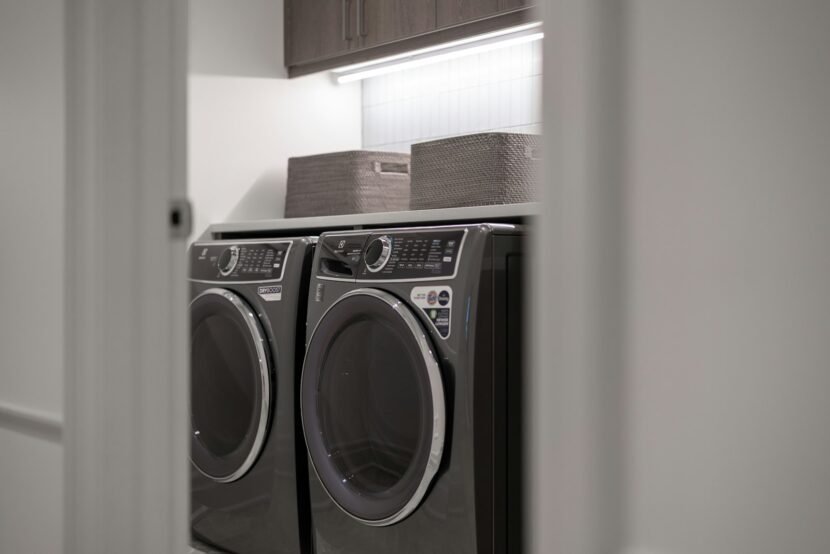
Side by side gives you a continuous surface across the top, which becomes the folding counter you would otherwise have to build. A single cut piece of butcher block or laminate laid over both machines turns them into a worktop, though it has to be liftable for servicing and it will vibrate unless you add a rubber mat underneath.
Front loaders can be stacked or sat side by side. A top loader can only sit beside another machine, and it needs clear headroom above the lid.
Storage that fits around machines
The usable storage in a laundry space is mostly vertical and mostly narrow.
- A slim rolling cart in the gap between a machine and the wall holds detergent and stain remover and pulls out when you need it. Measure the gap first, since these carts come in a few standard widths.
- Over-the-door racks on the inside of a laundry room door hold sprays, brushes, and dryer sheets.
- Magnetic containers stick straight to the side of the machines and keep clothespins and small tools off the shelf.
- A single wall-mounted rail with hooks carries the lint brush, the mesh bags, and whatever else usually ends up on top of the dryer.
- Stackable bins for sorting work better than a single large hamper if more than one person uses the space.
Decant detergent into a jar or dispenser only if you will keep the dosing instructions somewhere. The scoop and the fill line on the original bottle are doing real work, and pouring by eye wastes detergent and leaves residue on clothes.
Drying without a dryer
If you air dry, the space needs airflow more than it needs racks. Wet laundry in a closed closet takes days and can leave a musty smell in the fabric.
Wall-mounted accordion racks fold flat against the wall and hold a surprising amount for their footprint. A ceiling-mounted pulley rack uses the warmest air in the room and stays out of the way entirely, though it needs a joist to fix into. A heated clothes airer costs more to buy and runs cheaply, and it dries a load overnight in a room that would otherwise stay damp.
Whatever you use, crack a window or run an extractor fan while clothes dry. Drying a full load indoors releases a lot of moisture into the air, and in a small apartment that shows up as condensation on the windows.
Renter-friendly updates
Laundry spaces in rentals tend to be the least finished room in the home, and most of what improves them comes back off at the end of the lease.
- Peel-and-stick floor tile over worn vinyl. A laundry closet is small enough that this is an afternoon, and the offcuts are minimal.
- Removable wallpaper on the back wall, which is the one surface you see when the doors are open.
- A washable rug or a runner in front of the machines, which is warmer underfoot and catches drips.
- Adhesive hooks and tension rods instead of anything screwed into the wall.
- A plug-in wall light or a rechargeable puck light where there is no fixture.
Check your lease before adhesive anything goes on a painted wall. Peel-and-stick products vary in how cleanly they come off, and the cheaper ones can lift paint.
Making it a room you do not mind standing in
Laundry rooms get treated as pure utility, which is why so many of them are lit by a single bare bulb and painted builder white. Small changes shift that.
Warm bulbs instead of cool white make the space feel less like a garage. One color on the walls, even a deep one, works here because the room is small and you are only in it for minutes at a time, so a color you would not commit to in a living room is fine. Matching containers for detergent and pods tidy the visual clutter more than any amount of reorganizing. A framed print or two on the one clear wall costs almost nothing and changes how the space reads.
For storage thinking that carries over from other tight spaces, see our small kitchen storage ideas and closet organization ideas for small closets. If you rent, the rental-friendly decor ideas guide covers what comes off cleanly, and small space organization ideas goes further on keeping storage from looking like storage.
Frequently asked questions
How much space do I need above a top loading washer?
Enough for the lid to open fully and stay open, which is usually somewhere around 18 to 20 inches depending on the model. Measure with the lid raised before you fix a shelf, because a shelf set by the closed height makes the machine unusable.
Can I put a countertop over my washer and dryer?
Over front loaders, yes, as long as the surface rests on supports at the sides rather than on the machines themselves, or is light enough to lift off for repairs. Vibration is the issue, so add rubber pads between the machines and the top. Do not build a fixed countertop over a top loader.
What is the best flooring for a laundry area?
Anything waterproof and easy to mop. Vinyl plank and tile both handle the occasional leak. If you rent and cannot change the floor, a waterproof mat under and in front of the machines protects what is there.
How do I stop my laundry closet smelling musty?
Leave the washer door and the detergent drawer open between loads so they dry out, move laundry to the dryer or a rack as soon as the cycle ends, and run a hot maintenance wash with the drum empty every month or so. If the closet has doors, leave them open for a while after a load rather than shutting damp air in.