The short version
Most small kitchen storage ideas are really decluttering advice in disguise. This one is not. Organising sorts what you already own; storage creates somewhere to put it. Below is how to find the dead space almost every small kitchen contains — vertical gaps in cabinets, unused wall and door interiors, dead corners, the strip beside the fridge — and roughly how much usable capacity each fix returns.
Organising and storage are different problems
Worth separating, because people usually attempt them in the wrong order.
- Decluttering reduces how much you own.
- Organising decides where the remaining things live and keeps them there.
- Storage increases how much space exists to put them in.
If you have already decluttered and organised and the kitchen still does not work, you do not have an organisation problem. You have a capacity problem, and no amount of tidying fixes it.
If you have not done the first two yet, start there instead — our guides to kitchen organisation for small kitchens and keeping counters clear for good cover the sorting and the habits. This article is what to do once those are done.
Find the dead space first
Before buying anything, open every cabinet and look for air above things. That gap between the top of your stacked plates and the shelf above is the single largest source of unused capacity in most kitchens, and it exists in nearly every cabinet.
Do this with a tape measure and write the numbers down. Almost every solution below depends on knowing an internal dimension, and almost every returned kitchen organiser was bought without one.
| Dead space | Fix | Rough capacity gain |
|---|---|---|
| Air above stacked plates or mugs | Shelf riser or stacking shelf | Close to double that shelf |
| Inside of cabinet doors | Over-door racks or adhesive hooks | Lids, wraps, small tools |
| Back of a deep corner cabinet | Turntable | Makes 100% reachable instead of ~60% |
| Wall between counter and wall units | Rail with hooks | Frees most of a utensil drawer |
| Narrow gap beside fridge or units | Slim rolling trolley | Three extra shelves |
| Under the sink around the plumbing | Two-tier under-sink shelf | Roughly doubles a wasted cupboard |
| Above wall cabinets | Baskets for rarely used items | Genuine long-term storage |
| Vertical space in a deep drawer | Dividers to file items upright | Ends stacking, doubles access |
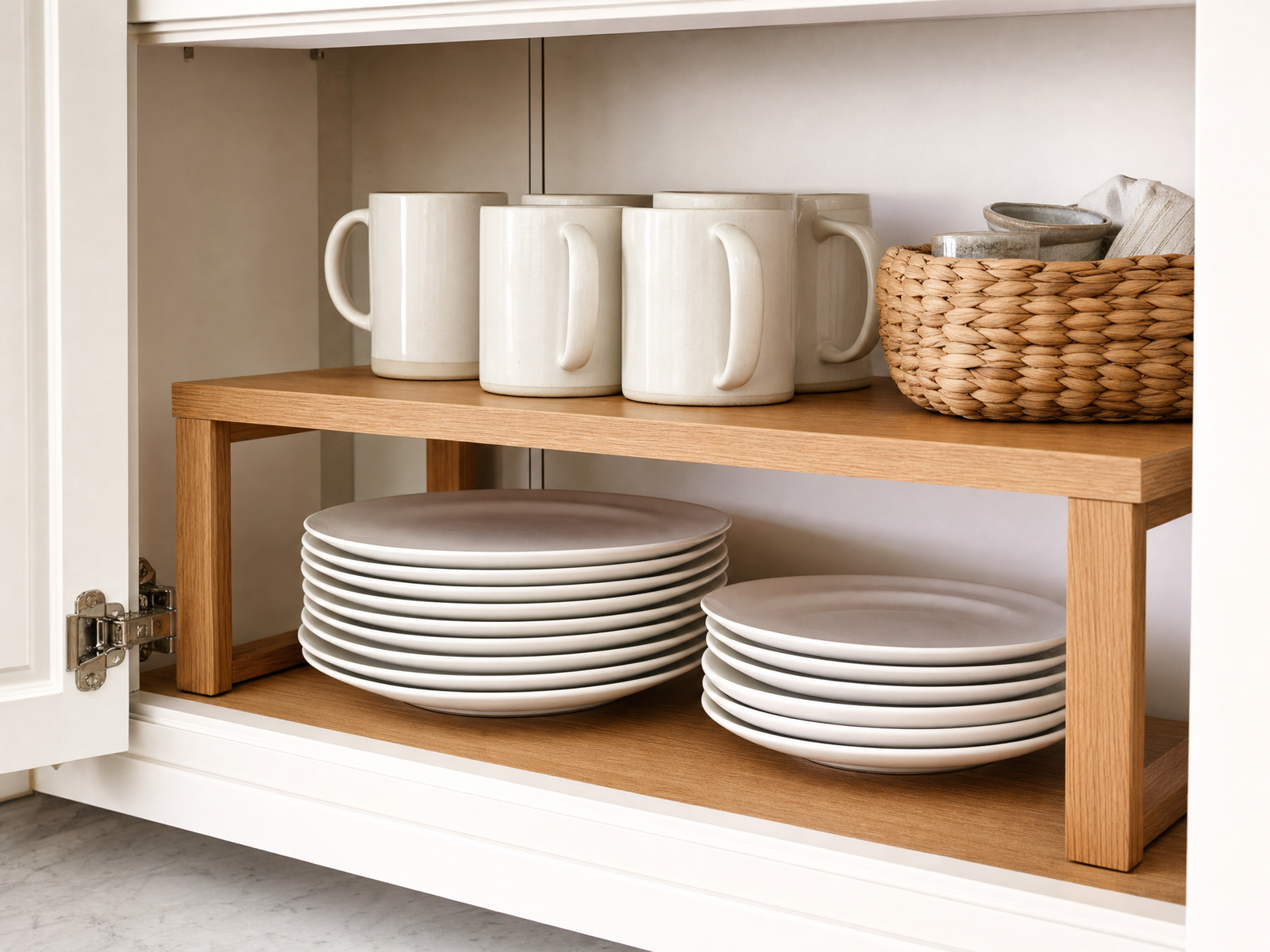
Vertical is where the capacity is
Kitchens are designed around standard shelf heights, which almost never match what you actually store. A shelf tall enough for cereal boxes is far too tall for mugs, and that mismatch is pure wasted volume.
- Shelf risers in cabinets holding plates, bowls or mugs. Measure internal height and internal depth before ordering — depth is what most people get wrong.
- Under-shelf baskets that clip onto an existing shelf and hang below it. Good for tea, wraps and small packets.
- File things upright, not stacked. Chopping boards, baking trays, pot lids and even food containers all take less space and are massively easier to reach standing on edge.
- Stack the fridge properly too. A small riser in a fridge works the same way, and fridge capacity is usually tighter than cabinet capacity.
Use the walls
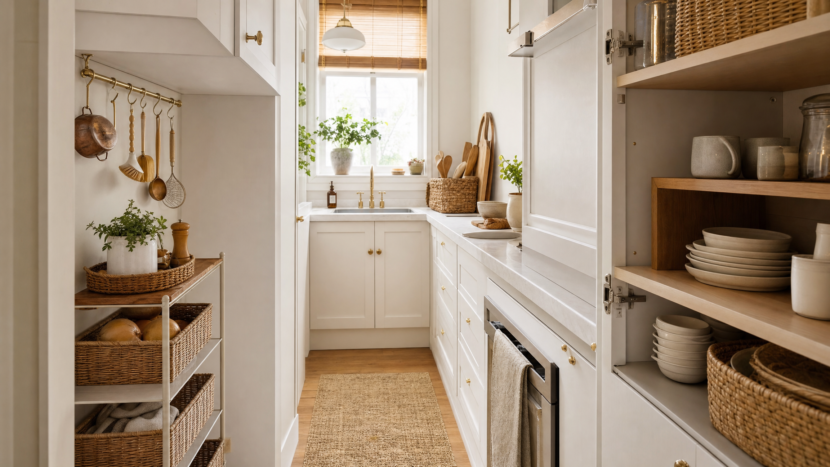
The strip of wall between the counter and the wall cabinets is usually decorative and nothing else. It is the most accessible storage in the room.
- A rail with S-hooks takes utensils, mugs, small pans and a spice shelf. One rail regularly frees an entire drawer.
- A magnetic knife strip removes the block, which is one of the largest counter objects in most kitchens.
- A narrow shelf at eye level for oils and daily seasonings keeps them off the counter without burying them in a cupboard.
- Pot rack if you have no cabinet space at all. Genuinely practical in a kitchen with few units, and it looks better than it sounds.
Renting? Rails, hooks and strips all come in adhesive versions rated for a few kilograms. Hang light items and check the weight rating rather than guessing.
Corners, doors and the gaps
Corner cabinets
A deep corner cabinet without a turntable is roughly 40% storage and 60% archaeology. A cheap lazy Susan converts the whole footprint into reachable space and is probably the highest return-per-pound item in this entire article.
Cabinet doors
The inside of every cabinet door is flat, vertical, unused space. Over-door racks suit pot lids, chopping boards, foil and cling film, and small cleaning bottles under the sink. Check the door closes before you commit to adhesive.
The gap beside the fridge
If you have 15–30cm of gap anywhere, a slim rolling trolley turns it into three shelves you can pull out. This is also the best solution for a kitchen with genuinely no spare cabinet — it adds both storage and a mobile work surface.
What not to buy
Money is easily wasted here.
- Anything bought before measuring. The most common failure by a wide margin.
- Multi-compartment organisers that impose a structure your items do not match. Simple open containers adapt; moulded ones do not.
- Matching container sets bought in one go. Buy for the space you measured, not for the photograph.
- Anything that needs to come out for you to reach what is behind it. If retrieving one item is a two-step operation, the system will be abandoned within a month.
- Extra storage for things you do not use. Storing an unused appliance more efficiently is still storing an unused appliance.
The order to do it in
- Empty and measure every cabinet interior. Write the numbers down.
- Fix the corner cabinet first — biggest gain, lowest cost.
- Add risers to the two cabinets with the most air above their contents.
- Hang one rail and move utensils out of the drawer.
- Put a two-tier shelf under the sink.
- Only then consider a trolley or anything freestanding.
Doing it in that order means each step frees space that changes what the next step needs to hold.
Frequently asked questions
How do I add storage to a small kitchen without renovating?
Target dead space rather than adding furniture. Shelf risers inside cabinets, a turntable in the corner unit, over-door racks, a wall rail and a two-tier shelf under the sink together add substantial capacity, cost relatively little, and require no structural work.
What is the single best small kitchen storage buy?
A turntable for a deep corner cabinet, if you have one. It converts the unreachable back portion of the cabinet into usable space, which is a bigger proportional gain than anything else at that price. After that, shelf risers.
How do I store things when I have almost no cabinets?
Go vertical on the walls and mobile on the floor. A rail system with hooks, a pot rack, a magnetic knife strip and a slim rolling trolley can replace most of a missing cabinet run, and none of it is permanent.
Do shelf risers actually work?
Yes, provided you measure internal cabinet depth as well as height. They roughly double the usable capacity of any shelf storing short items like mugs, bowls or plates. They do nothing for shelves already holding tall items.
What can renters do?
Almost all of this. Risers, turntables, under-sink shelves, over-door racks and trolleys are entirely freestanding. Rails, hooks and knife strips come in adhesive versions — just check the weight rating and hang the lighter items.
How do I keep it from reverting?
Capacity does not maintain itself. Once you have added the space, the habits matter — our guide to keeping kitchen counters clear for good covers the daily reset that stops a well-stored kitchen drifting back.
Where to take this next
For the sorting-and-systems half of the problem, see kitchen organisation ideas for small kitchens. If the kitchen is also a rental you cannot alter, our rental kitchen makeover ideas and small apartment kitchen cabinet guide cover what is possible without tools. And for storage across the rest of the home, small space organisation ideas applies the same dead-space thinking room by room.