Good living room decor ideas for renters work within the lease, not against it. You cannot repaint, rewire or drill freely, but you can still make a rented living room feel personal, warm and finished for roughly $150 to $600 if you choose the right pieces and move them with you later.
This guide walks through nine renter-safe upgrades in the order that gives the biggest visual return, from lighting and rugs to gallery walls and storage. Everything is removable, so your deposit stays safe. If you want even more damage-free options, our guide to rental-friendly decor ideas that cause zero damage pairs well with this one.
Check Your Lease Before You Start
Most tenancies allow small picture hooks and adhesive strips, many prohibit painting, and almost all ban structural changes. Read the decoration clause, and if anything is unclear, email your landlord and keep the reply. Written permission for something like a painted accent wall or a single wall-mounted shelf can turn a maybe into a safe yes.
Take dated photos of walls, floors and fixtures when you move in or before you start. If you ever need to prove that a mark was already there, those photos protect your deposit. Keep original items you swap out, such as light shades or cabinet knobs, in a labeled box so you can refit them when you leave.
Replace Harsh Lighting With Layers
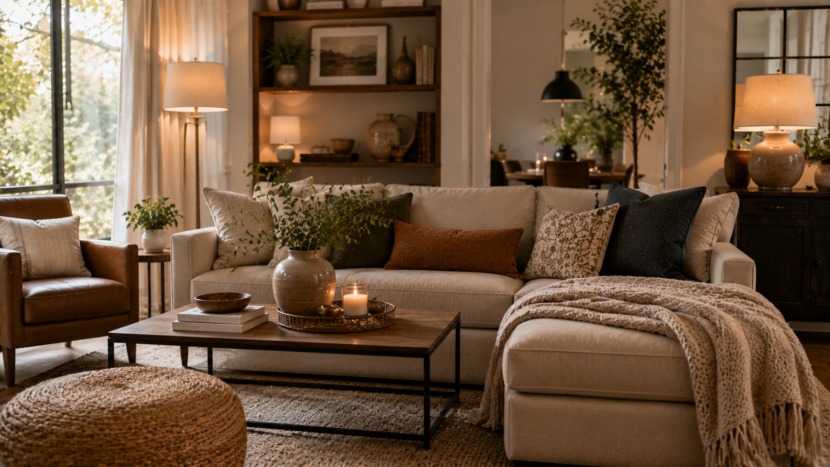
Lighting changes a rental living room more than any rug or cushion. Turn off the ceiling light if you can and use three sources at different heights: a floor lamp in the corner, a table lamp on a side table or shelf, and a string of warm LED lights or a small accent lamp low down.
Swap cool white bulbs for warm white around 2700K, and replace a dated ceiling shade with a plug-in pendant lamp hung from a ceiling hook if your landlord allows it. A decent floor lamp costs about $35 to $90, and a table lamp about $20 to $60. Dimmable smart bulbs ($8 to $15) let you adjust mood without any rewiring.
Anchor the Room With a Large Rug
Rental flooring is often worn laminate, beige carpet or tired vinyl. A big rug covers it, defines the seating area and adds warmth underfoot. In a typical living room, choose a rug at least 5 by 8 feet, and ideally 8 by 10, so the front legs of the sofa and chairs sit on it.
Neutral flat-weave or low-pile rugs in oatmeal, rust or soft blue-gray go with the widest range of furniture, and cost about $80 to $250. Add a non-slip grip underneath on hard floors, and on carpet use a thin rug pad plus rug tape at the corners to stop curling.
Create a Gallery Wall With Adhesive Strips
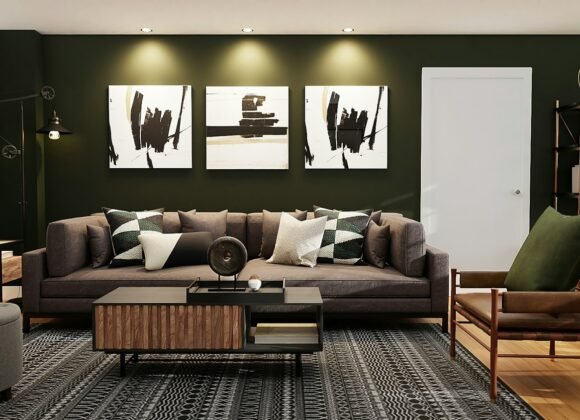
A gallery wall is the best answer to blank white rental walls. Lay frames on the floor first, trace each one on kraft paper, and tape the paper templates to the wall to adjust spacing before sticking anything up. Keep gaps of 2 to 3 inches between frames, and stay within one or two frame finishes such as black and oak.
Use adhesive strips rated well above each frame’s weight, and press them firmly for 30 seconds. Remove them later by pulling the tab slowly parallel to the wall. Prints from online shops, family photos, pages from vintage books and even framed fabric all work, and a set of eight frames costs about $50 to $150.
Hang Floor-Length Curtains on a Tension Rod
Curtains are the quiet hero of rental living rooms. Hang them higher and wider than the window, ideally 4 to 6 inches above the frame and 8 to 12 inches either side, so the window looks larger. A tension rod works inside a recess without any drilling, and a heavy-duty curtain rod with removable adhesive brackets works for lighter fabrics.
Linen-blend panels in warm white or sand soften light and add texture for about $30 to $90 per pair. If the window sits in a recess, take the curtains off a tension rod when you move and reuse them in your next place, which makes them one of the smartest rental investments. For more window ideas, read our curtain ideas for small rooms.
Use Removable Wallpaper or Wall Decals Carefully
Peel-and-stick wallpaper can transform a single wall behind the sofa, but it needs good prep. Test a small patch in a hidden area first, wait 48 hours and peel it to see whether it pulls paint. Matte, smooth walls take it best; textured walls and fresh paint often do not.
For a lower-risk option, hang a large framed print, a woven wall hanging or a tapestry from removable hooks. Our guide to removable wallpaper ideas for rentals covers products and application tips in more detail. Budget about $40 to $120 per roll of quality removable paper.
Use Plants and Textiles to Add Life
Plants are the rare decor item that no lease can restrict. Mix one large floor plant such as a rubber plant, fiddle-leaf fig or snake plant ($25 to $80) with a trailing pothos on a shelf and a small herb or succulent on the coffee table. Odd numbers and varied heights look natural.
Layer textiles for warmth: two cushions in different textures, a chunky knit throw over the sofa arm and a wool-blend blanket in a basket. Stick to a palette of three colors so everything still looks calm. Cushion covers ($10 to $25 each) are cheaper than new inserts, and they are easy to swap with the seasons.
Choose Furniture That Travels With You
In a rental, buy furniture you will want in the next three homes. A solid sofa in a neutral fabric, a bookcase that works in several room sizes and a coffee table with storage will outlast any lease. Avoid very large sectionals that only fit one layout, and look for modular or flat-pack pieces that dismantle easily.
If the budget is tight, thrift stores and secondhand marketplaces often have solid wood side tables and shelves for $20 to $80 that can be refreshed with new knobs or a coat of removable-friendly furniture paint. Our thrift store decor flips shows what works well. Measure doorways and stairwells before you buy, so large pieces actually arrive.
Arrange the Layout Around One Focal Point
Choose one focal point, such as the window, a bookshelf wall or a TV unit, and angle seating towards it. Pulling the sofa 6 to 8 inches off the wall can make a small room feel more intentional, and floating a sofa behind a console table is a good way to create a hallway or study corner in a studio.
Keep walkways around 30 to 36 inches wide so the room does not feel cramped. For help with tricky rooms, see our guide on how to arrange furniture in a small living room, and keep tall pieces against walls to preserve sightlines.
Hide Clutter With Closed Storage
Clutter is the quickest way to make a rental feel temporary. Use baskets with lids, a storage ottoman and a bookcase with a mix of closed bins and open shelves. Keep open shelves about two-thirds full, with a few objects and books laid flat for rhythm.
A media console with doors, a console table with baskets underneath and a slim shoe cabinet near the door can hide remotes, chargers and mail. Expect to spend about $40 to $150 per piece. If you are short on floor space, vertical shelving anchored with a renter-safe anti-tip strap is better than adding another low unit.
What These Upgrades Cost
You do not need to do everything at once. Start with lighting, a rug and curtains, then add the rest over a few months. Prices below are typical ranges and vary by retailer and region.
| Upgrade | Budget option | Mid-range option |
|---|---|---|
| Lighting (floor and table lamps) | $40 to $80 | $120 to $250 |
| Large rug | $80 to $150 | $200 to $450 |
| Curtains and rod | $40 to $80 | $100 to $200 |
| Gallery wall frames and prints | $50 to $100 | $120 to $250 |
| Plants and pots | $30 to $60 | $80 to $150 |
| Cushions and throw | $30 to $60 | $80 to $160 |
A budget version totals roughly $270 to $530, while a more upscale setup runs about $700 to $1,460. For more affordable ideas, browse our apartment decorating ideas for renters on any budget.
Frequently Asked Questions
How can renters decorate a living room without damaging walls?
Use adhesive picture strips rated above your frame weight, tension rods for curtains, freestanding lamps and shelves, and removable wallpaper tested on a hidden patch first. Lean large mirrors and art on a console instead of hanging them. These methods change the look dramatically while leaving paint and plaster untouched.
What is the best first upgrade for a rental living room?
Lighting usually gives the biggest improvement for the lowest cost. Switch cool bulbs to warm 2700K and add a floor lamp plus a table lamp so the ceiling light can stay off. After lighting, a large rug and floor-length curtains make the room feel finished and cozy.
How much should I spend on renter-friendly decor?
A solid starting makeover typically costs about $270 to $530 using budget and secondhand pieces, or $700 to $1,460 for a more polished mid-range look. Buy pieces in stages and prioritize items that move with you, such as lamps, rugs, curtains and good furniture.
Can I paint a rental living room?
Only with written permission from your landlord, and often with a requirement to repaint before you leave. If painting is not allowed, use peel-and-stick wallpaper on one wall, large artwork, or a tapestry. Always test removable products on a small hidden patch before committing to a full wall.