A productivity room is any space — a spare bedroom, a corner, even a wide hallway — deliberately set up so your brain associates it with focused work. You do not need a dedicated office to have one. What you need is separation, directional light, controlled sound, and a setup ritual. Here is how to build all four in a small rented space.
What makes a room a “productivity room”?
Psychologists call it context-dependent memory: your brain links places with activities. If you work where you sleep or scroll, every session starts with friction. A productivity room — even a productivity corner — works because it is used for one thing. The four ingredients: a visual boundary, task lighting, a clutter-free desk zone, and something that marks the start of a session (same playlist, same candle, same drink).
Pick the right spot (it is probably not where you think)
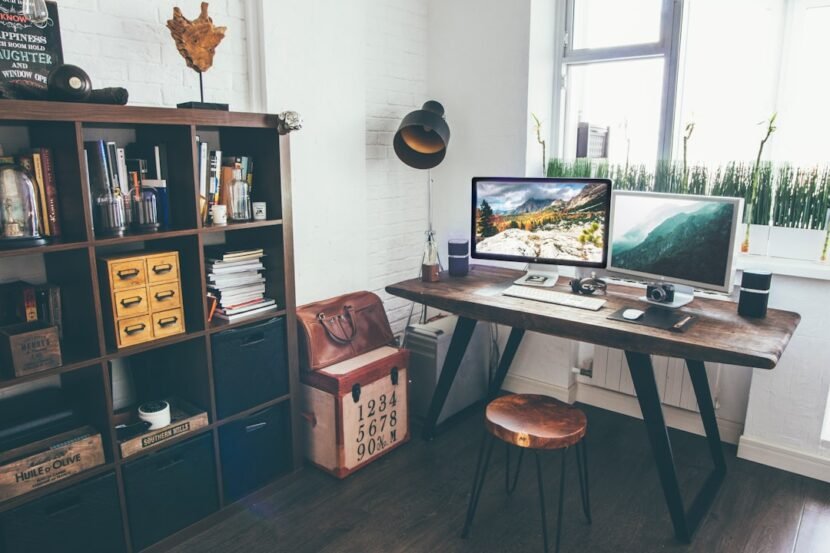
The best productivity spot in a small home faces a wall or window, not the room. Facing the room means facing the dishes, the sofa, and the bed — three open invitations. Corners work brilliantly: two walls of separation for free. If your only option is the bedroom, position the desk so the bed is behind you, and use a room divider or open shelf as a boundary.
Lighting: the difference between focus and fatigue
Work under cool-to-neutral light (3500–4500K) and relax under warm light — the contrast itself signals “work mode.” The ideal setup costs under $40: a daylight desk lamp angled from your non-dominant side, plus natural light from a window at 90 degrees to your screen (never behind it). If your space is dark, our guide to small room lighting shows how to layer light without wiring.
The desk zone: less on it, more done
The rule that survives contact with real life: only today’s work lives on the desk. Everything else — chargers, papers, the second mug — gets a home in a drawer, rolling cart, or wall organizer. A rolling cart is the renter’s secret weapon: your entire office rolls into a closet at 6 pm, which is exactly the separation ritual small spaces lack. For more compact setups, see our home office ideas for small spaces.
Sound: the most ignored productivity factor
Hard, bare rooms echo, and echo is exhausting. Soft materials fix it cheaply: a rug, curtains, a fabric pinboard, even a blanket folded over a chair back. If you share walls, noise-cancelling headphones with a consistent playlist double as your start-of-session ritual. Research on open-plan noise from the American Psychological Association consistently links unpredictable background speech with reduced concentration — predictable sound (music, brown noise) is far less disruptive than intermittent noise.
Renter-friendly extras that earn their space
- A vertical wall organizer on damage-free hooks — papers off the desk, nothing drilled.
- One plant — a pothos or snake plant softens the zone and needs near-zero care.
- A dedicated “done” tray — finished work physically leaves the active zone.
- A timer that is not your phone — the phone stays out of reach; a $10 kitchen timer runs your focus blocks.
- A footrest or cushion — comfort you control keeps you in the chair longer than willpower does.
Frequently asked questions
How do I make a productivity room in a studio apartment?
Define a corner with a rug, face the desk toward the wall, use an open shelf or curtain as a boundary, and pack the setup into a rolling cart at the end of the day. The boundary matters more than the square footage.
What should I put in a productivity room?
A desk facing a wall or window, a task lamp, closed storage for everything not in use, one soft surface for acoustics, and a start-of-session ritual object. Skip the motivational posters — clear surfaces motivate more.
What colors are best for a productivity room?
Muted, low-stimulation tones: soft greens, warm neutrals, muted blues. High-saturation colors work as a single accent, not a wall. Pair with our warm minimalist decor ideas for the full look.