American homes have shrunk by an average of 323 square feet since 2015 — while prices jumped 46% over the same decade (U.S. Census Bureau, via Harvard Joint Center for Housing Studies, 2025). You’re paying more for less, and that cramped bedroom or poky living room isn’t going anywhere. But here’s the thing: a room’s actual size and how big it feels are two completely different things — and the gap between them is almost entirely in your control.
Interior designers have been closing that gap for decades using tricks that cost next to nothing. A strategically placed mirror, the right shade of paint, or a curtain rod hung 6 inches higher can do more for a small room than a $2,000 sofa ever could.
This guide walks you through seven budget-friendly steps — in order of impact — so you can start seeing results from day one. Whether you’re decorating a small bedroom, a cozy apartment living room, or a renter-friendly small room with no structural changes allowed, these tricks work.
⚡ Quick Wins — Do These in 30 Minutes (Free)
- Pull all furniture 2–3 inches away from the walls
- Clear every surface to 80% capacity — put the rest away
- Clean your windows to let in maximum light
- Move your existing curtain rod as high as it will go
- Group small decorative objects into clusters of 3 or 5
These five changes cost nothing and take under 30 minutes. Do them first, then work through the steps below at your own pace.
Key Takeaways
- New U.S. homes hit a 10-year low in 2024 — median 2,150 sq ft (64 m²), down from 2,500 sq ft (232 m²) in 2013 (Harvard Joint Center for Housing Studies, 2025)
- Strategic mirror placement creates the visual impression of a second window — with no structural changes
- Light paint colors, vertical storage, and multi-purpose furniture deliver the biggest impact for the smallest spend
- 78% of homeowners reported their space felt 30–50% larger after adopting a unified light color scheme (National Association of Home Builders, 2025)
Before You Start: What You’ll Need
Estimated budget: $0–$150 total (most steps cost nothing)
Time: A weekend for the full overhaul; individual steps take 30 minutes to a few hours
Difficulty: Beginner — no tools or trade skills required
- A measuring tape
- Painter’s tape and a roller (if painting)
- A command hook or two
- Good lighting (natural or a standing lamp)
The order matters. Paint first, furniture second, accessories last — doing it the other way around means constantly rearranging around wet walls.
Step 1: Paint Walls in a Light, Unified Color
By the end of this step, you’ll have a room that immediately reads as larger, brighter, and more cohesive — before you’ve moved a single piece of furniture.
Color is the highest-leverage change in a small room. Light shades reflect more natural light back into the space, which is why designers consistently call it the single most impactful budget move. A 2025 survey by the National Association of Home Builders found that 78% of homeowners with small rooms under 200 sq ft (18.5 m²) reported their space felt 30–50% larger after adopting a unified color scheme (NAHB, 2025).
Why unified? Contrast between walls, ceiling, and trim creates visual “breaks” that your eye interprets as edges — edges signal boundaries, which make rooms feel smaller. Paint everything the same soft tone and those edges disappear.
What to do:
- Choose a soft neutral: warm white, soft cream, pale greige, or barely-there sage
- Paint walls and ceiling the same color (or one shade lighter for the ceiling)
- If you have woodwork or trim, paint it the same tone rather than bright white
- Use a satin or eggshell finish — it reflects more light than flat matte
✓ Verification: Stand in the doorway after it dries. The room should feel like it exhales slightly compared to before.
💡 Our experience: The single biggest mistake is stopping at the walls. Painting the ceiling the same color — or a half-shade lighter — eliminates the visual “lid” that makes a room feel like a box. It’s a trick most guides skip.
What this costs: A gallon of quality paint runs $25–$45 and covers roughly 350 sq ft (32 m²). A typical small bedroom takes less than a gallon.
📌 [INTERNAL-LINK: For bedroom-specific color ideas → “Best Paint Colors for Small Bedrooms”]
Step 2: Hang Mirrors Strategically
By the end of this step, you’ll have the visual equivalent of adding a window — bouncing light around and making the room appear to extend beyond its walls.
Mirrors are the most effective single item you can add to a small room. They work by reflecting both light and the space itself, creating the illusion of depth. Designer Irene Gunter explains it well: a mirror placed opposite a window creates a visual extension of the view, making the room feel much larger than it actually is (Homes & Gardens, 2023).
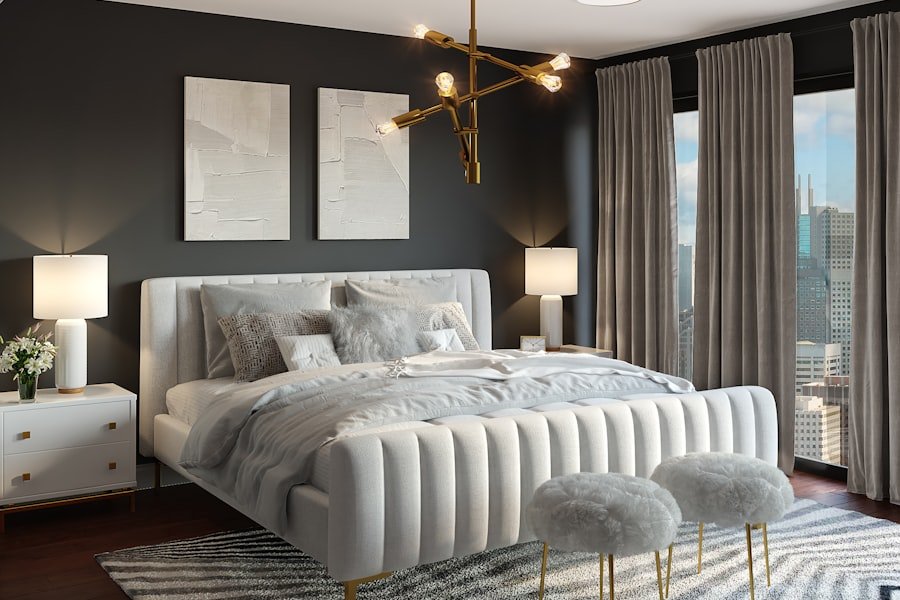
What to do:
- Identify your room’s natural light source (window or glass door)
- Hang a large mirror on the wall directly opposite that light source
- If your room has angled or awkward walls, that’s actually the ideal spot — it reflects from multiple angles
- For rooms with no wall big enough, use mirrored furniture: a mirrored console table or wardrobe door achieves the same effect
Size matters: Go as large as the space can handle, with as small a frame as possible. An oversized mirror with a slim metal frame beats a small ornate one every time.
✓ Verification: Stand at the doorway and look across the room. The mirror should appear to “open” the far wall rather than just reflect back at you.
What this costs: Thrift stores and Facebook Marketplace regularly sell large frameless mirrors for $10–$30. New budget versions at IKEA (HOVET, Nissedal) run $30–$80.
Step 3: Clear the Floor — Add Vertical Storage Instead
By the end of this step, you’ll have more visible floor space without losing any storage capacity — and a room that feels significantly more open.
Every square foot of bare floor sends a signal to the brain: open space here. Furniture and clutter on the floor interrupt that signal constantly. The solution isn’t to own less — it’s to move storage up. Vertical storage is one of the dominant 2026 interior trends precisely because it frees floor area while drawing the eye upward, which also makes ceilings feel taller — great for small bedroom storage ideas and apartment living rooms alike.
What to do:
- Audit everything currently on your floor: what’s there that doesn’t need to be?
- Replace low, wide storage pieces (squat bookshelves, wide dressers) with tall, narrow alternatives
- Add wall-mounted shelves above existing furniture to reclaim surface space
- Use the vertical space above doors: add a shelf for rarely-used items
- Mount your TV on the wall rather than on a unit if you haven’t already
Practical rule of thumb: If a piece of furniture is shorter than your waist, it’s eating floor space your eye registers as “taken.” Go tall or go wall-mounted.
✓ Verification: Take a photo from the doorway. More floor should be visible than before.
What this costs: Command hooks for light wall shelves: $8–$15. Basic floating shelves: $15–$40.
Step 4: Hang Curtains High and Wide
By the end of this step, you’ll have windows that appear dramatically taller, ceilings that feel higher, and a room that reads as more generous — without touching a wall.
This is one of the most overlooked and highest-impact tricks available. Most people hang curtain rods right above the window frame. Designers hang them just below the ceiling. Your eye follows the curtain from ceiling to floor and reads the curtain height as ceiling height. Extending the rod 6–12 inches past each side of the window makes it appear much wider too, letting in more light even when open.
What to do:
- Remove your existing curtain rod if it’s mounted within 4 inches of the window frame
- Remount the rod 2–4 inches below the ceiling (or as high as your wall allows)
- Extend the rod 6–12 inches past each side of the window frame
- Use floor-length curtains — they must reach the floor for the full effect
- Choose light, airy fabrics in a tone close to your wall color (contrast breaks the visual flow)
✓ Verification: Step back to the doorway. The window should look larger and the ceiling should feel higher than before.
What this costs: Curtain rod brackets: $8–$15. Sheer or linen curtain panels from IKEA (LILL, AINA): $10–$30 per panel.
📌 [INTERNAL-LINK: → “Best Curtain Colors for Small Living Rooms”]
Step 5: Choose Multi-Purpose Furniture — and Leg It Up
By the end of this step, you’ll have furniture that earns its floor space twice over — and a room with more visual “air” than before.
In 2026, every piece of furniture in a small room should justify its footprint by doing at least two jobs. A storage ottoman instead of a coffee table. A bed with drawers underneath. A fold-down dining table. A sofa bed for guests. These pieces compress the number of items in a room while preserving function — and they’re the backbone of any cozy apartment living room idea that actually works.
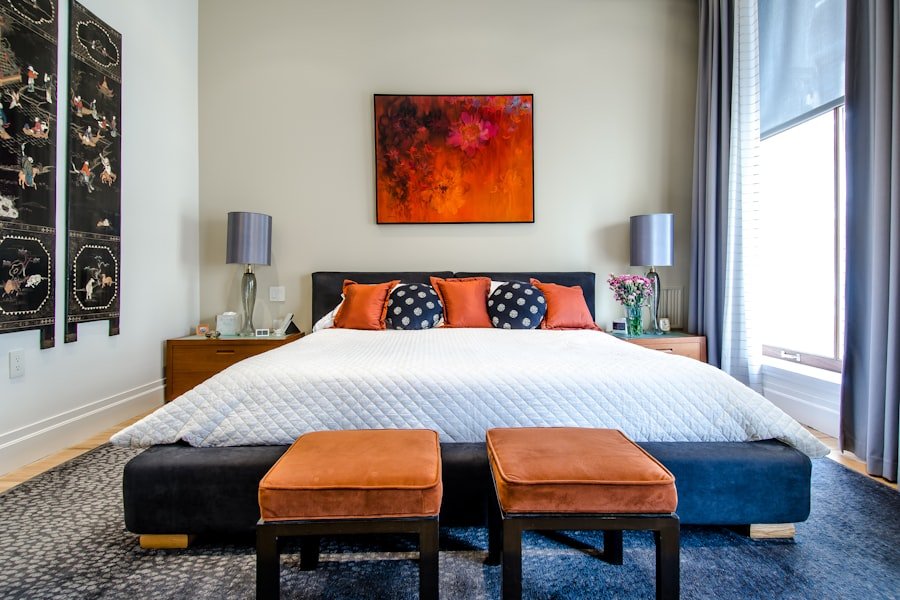
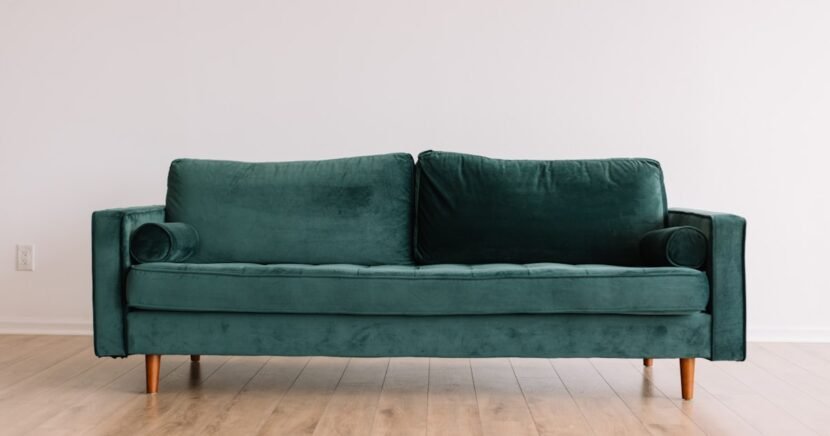
The “legs” rule: Furniture on legs rather than flush to the floor exposes the floor beneath, making the room feel more open. A sofa that reveals 6 inches of floor underneath looks lighter and airier than the same sofa as a floor-sitting piece.
What to do:
- Audit your furniture: what pieces have only one function?
- Swap floor-sitting pieces for versions with visible legs where possible
- If you can’t swap, use furniture risers ($10–$20) to lift existing pieces
- Remove any furniture that isn’t earning its square footage
✓ Verification: Can you see under and through your furniture? The room should feel more breathable.
What this costs: Furniture risers: $10–$20. IKEA KALLAX storage cube with insert legs: $30–$60. Storage ottomans: $40–$80.
📌 [INTERNAL-LINK: → “Small Living Room Furniture Ideas That Actually Work”]
Step 6: Maximise Light — Natural and Artificial
By the end of this step, you’ll have a room that feels brighter and more open at any time of day, using what you already have.
Light and space are inseparable in how the brain reads a room. A well-lit small room feels larger than a dim one twice its size. Natural light is your most powerful tool — your job is to amplify it rather than block it.
What to do:
- Remove anything blocking windows: heavy curtains, furniture pushed against the glass, plants crowding the sill
- Clean your windows — dirty glass blocks more light than you’d think
- Swap heavy curtains for sheers or remove window coverings entirely if privacy allows
- Add a floor lamp in the room’s darkest corner — pools of warm light expand perceived edges
- Replace any single overhead bulb with warm-white LED (2700–3000K)
💡 The layered lighting rule: A room with one bright overhead light feels smaller than a room with two dimmer lamps at different heights. Multiple light sources create depth; a single source flattens everything.
✓ Verification: At dusk, turn off the overhead and use only lamps. Does the room feel cosier and larger simultaneously? That’s the target.
What this costs: LED bulb swap: $3–$8 per bulb. A basic floor lamp: $25–$60.
Step 7: Declutter and Maintain the 80% Rule
By the end of this step, you’ll have a room where what remains has space to breathe — and every inch looks intentional.
Clutter is the most reliable way to make any room feel smaller. It’s also the only step on this list with zero cost. Interior designers call it the 80% rule: surfaces, shelves, and storage should never be more than 80% full. That remaining 20% of visible space is what allows the eye to rest, move freely, and perceive the room as spacious rather than crammed.
What to do:
- Remove everything from all surfaces: countertops, shelves, floors
- Add back only what you actually need and love — apply the 80% rule as you go
- Pull furniture slightly away from walls (even 2–3 inches) to create natural flow
- Group smaller decorative objects in odd numbers (3 or 5) — clusters read as intentional, scatter reads as clutter
- Store remaining items out of sight in the vertical storage from Step 3
💡 The “pull from the wall” rule: Most people push all furniture against walls to “save space.” Interior designers consistently recommend pulling pieces inward slightly to create a natural path — it’s one of the most effective renter-friendly small room ideas that costs absolutely nothing.
✓ Verification: Stand in the doorway. Is there a clear path through the room? Are surfaces mostly clear? Does the eye move freely? If yes — you’ve done it.
What this costs: $0.
Common Mistakes That Make Small Rooms Feel Even Smaller
Even experienced decorators fall into these traps.
1. Using too many different colors
Pattern and color contrast create visual “noise.” Every transition reads as a boundary, and more boundaries mean more perceived walls. Stick to one or two tones in a small room.
2. Hanging curtains at window height
As covered in Step 4, this is one of the most common and easiest-to-fix errors. Curtains at window height cap your ceiling visually. Always go as high as you can.
3. Choosing a rug that’s too small
A rug that only fits under the coffee table breaks the floor into competing zones. The right rug should be large enough that all main furniture pieces have at least their front legs on it.
4. Overcrowding with small decorative items
Ten small decorative pieces make a room feel cluttered. Two or three larger, deliberate pieces make it feel curated. One large piece of art beats four small frames every time.
💡 The mistake we see most often: people buy small-scale furniture thinking it will “fit better” in a small room. But undersized furniture actually makes a room feel smaller — it reinforces just how little space there is. One well-proportioned sofa beats three undersized armchairs in a small living room every time.
What Success Looks Like
If you’ve followed these steps, here’s what you should have now:
- ✅ Walls and ceiling painted in a unified light tone
- ✅ A large mirror opposite your main light source
- ✅ Visible floor space with clutter stored vertically
- ✅ Curtains hung near the ceiling, floor-length
- ✅ Furniture on legs with more than one purpose
- ✅ Light layered from multiple sources at different heights
- ✅ Surfaces at 80% capacity or less
Taken together, these changes cost between $0 and $150 — and deliver results that renovation budgets ten times larger can’t replicate, because the changes are perceptual, not structural.
Frequently Asked Questions
How do you make a small room look bigger without spending money?
Declutter and rearrange. Pull furniture 2–3 inches away from walls, clear all surfaces to 80% capacity, and group small objects into clusters of 3 or 5. These changes alone can dramatically alter how a space reads — no budget required.
What color makes a small room look bigger?
Light warm neutrals — soft white, warm cream, pale greige, or barely-there sage — consistently make rooms feel larger because they reflect more natural light. A 2025 NAHB survey found 78% of homeowners felt their room was 30–50% larger after switching to a unified light color scheme. The key: paint ceiling and walls the same tone to eliminate the visual “lid.”
Does a mirror actually make a room look bigger?
Yes — but placement is everything. A mirror placed opposite a window reflects both light and the outdoor view, creating the impression of a second window and extending the room’s perceived boundaries. Go large, use a slim frame, and aim it directly at your best light source.
Should furniture be pushed against the walls in a small room?
Counterintuitively, no. Pushing everything to the edges makes a room feel like a waiting room. Pulling furniture 2–3 inches inward creates natural pathways and visual flow that makes a space feel intentional and more spacious.
What’s the cheapest way to make a room look bigger?
In order of cost: (1) Declutter — free; (2) Rearrange furniture — free; (3) Clean windows — free; (4) Hang curtains higher — free if you own the rod. After that, a $25–$45 can of light paint delivers the highest impact per dollar of any paid change.
The Bottom Line
American homes are shrinking and prices keep climbing — but how a room feels is entirely separate from how many square feet it actually has. A unified paint color, a well-placed mirror, floor-to-ceiling curtains, and visible floor space will do more for a small room than most renovations costing thousands.
Start with the paint (Step 1) and the mirror (Step 2). Those two changes alone will transform the room. Add the remaining steps as budget and time allow.
Done? Take a before-and-after photo from the doorway. The difference will be clearer in photos than standing in the space — and it’ll remind you how much you’ve achieved for very little.
📌 [INTERNAL-LINK: Related reading → “Budget Bedroom Makeover: 10 Swaps Under $50” | “Small Bedroom Storage Ideas That Actually Work”]
Will it actually fit?
Use our free furniture planner — enter your room size and see exactly which pieces fit, with layout tips for your space.