The fastest way to make a small room look bigger is to raise your curtains, add one large mirror opposite the window, and swap heavy furniture for pieces with visible legs. Those three changes alone can make a room feel noticeably larger — and none of them require permission from a landlord. Below are all 20 tricks we use, ordered by impact.
Start with light: the biggest lever you have
1. Hang curtains high and wide. Mount the rod 10–15 cm below the ceiling (or as high as your rental allows with a tension rod) and extend it 20–30 cm past the window frame on each side. The window reads larger, the ceiling reads taller, and the wall feels wider. Our full guide to curtain ideas for small rooms covers fabrics and lengths.
2. Use one large mirror, not several small ones. A single full-length or oversized mirror placed opposite or adjacent to the window doubles the perceived light. Several small mirrors fragment the wall and add clutter.
3. Layer three light sources. One overhead light flattens a room. A floor lamp in a dark corner plus a table lamp at mid-height creates depth, and depth reads as space. We break this down in our small room lighting guide.
4. Keep window sills clear. Every object between you and the window shortens the room. Plants belong beside the window, not on the sill.
Furniture: scale and legs matter more than quantity
5. Choose furniture with visible legs. Sofas, beds and sideboards raised on legs let light pass underneath, so the floor appears continuous. A skirted sofa visually eats half a square metre.
6. One properly sized sofa beats a sofa plus two armchairs. Crowding seating makes a room feel like a waiting area. If you need extra seats, use stools that tuck away.
7. Float furniture off the walls — slightly. Even 5–10 cm of air behind a sofa creates the impression that the room has space to spare. Pushing everything flat against walls does the opposite of what you expect. See how to arrange furniture in a small living room for layouts that work.
8. Go low near windows, tall against solid walls. Low-profile furniture under windows preserves the light line; a single tall bookcase against a solid wall pulls the eye up and makes the ceiling feel higher.
9. Choose double-duty pieces. An ottoman with storage, a bed with drawers, a nesting side table set — every function you combine removes one object from the floor.
Color and pattern: continuity beats contrast
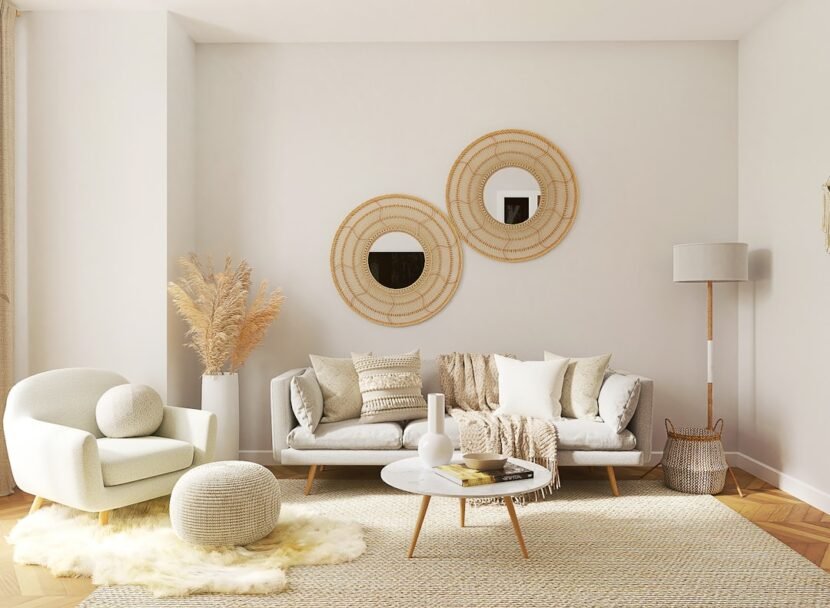
10. Keep walls, ceiling and large furniture in one tonal family. High-contrast blocks chop a room into zones. A room in layered warm neutrals reads as one continuous volume. Our warm neutral living room guide shows the palette in practice.
11. If you love dark colors, commit fully. A single dark accent wall shortens the room. Painting all walls (where allowed) in a deep tone blurs the corners and can actually make a small room feel deeper — designers use this constantly.
12. One large-scale pattern maximum. A single bold rug or one patterned wall works. Pattern on curtains, cushions, rug and bedding simultaneously visually shrinks the room.
13. Match your rug to the room, not the coffee table. A rug that fits just under the coffee table is the most common small-room mistake. The front legs of all seating should sit on the rug — a bigger rug genuinely makes the floor look bigger.
Sight lines and clutter: what the eye travels past
14. Keep the entry sight line clear. Whatever you see first from the doorway defines the room. If that line runs uninterrupted to the window, the room feels open regardless of its size.
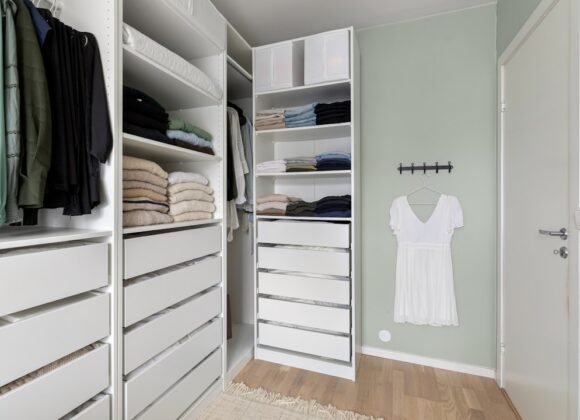
15. Use closed storage for 80% of your things. Open shelving displays clutter as décor only when it is curated. Baskets, lidded boxes and cabinet doors hide visual noise. Our small closet organization ideas help upstream of the problem.
16. Leave 30% of every surface empty. Shelf, dresser, coffee table — empty space on surfaces is what makes the difference between styled and stuffed.
17. Go vertical with décor, not horizontal. One tall plant or a vertical gallery strip draws the eye upward. A long horizontal row of frames widens the wall but lowers the perceived ceiling.
Three finishing tricks from stagers
18. Use transparent materials where you can. A glass or acrylic coffee table does its job while visually disappearing.
19. Repeat one accent color exactly three times. Repetition creates intentionality; the eye reads an intentional room as larger than a chaotic one.
20. Photograph your room from the doorway. A photo flattens the space and reveals bottlenecks your adapted eye no longer sees. Fix whatever looks cramped in the photo first.
How to make a small room look bigger: frequently asked questions
What colors make a small room look bigger?
Light, warm neutrals (soft white, cream, sand) with low contrast between walls and large furniture. But continuity matters more than lightness — an all-over deep green room can feel larger than a white room with one dark accent wall.
Do mirrors really make a room look bigger?
Yes — one large mirror reflecting a window can roughly double the perceived light in a room. Placement matters: opposite or perpendicular to the main light source, never reflecting a cluttered corner.
What furniture makes a small room look bigger?
Leggy, low-profile, correctly scaled pieces: a sofa on visible legs, a glass coffee table, nesting tables, and one tall storage piece instead of several short ones.
For the full room-by-room treatment, start with our pillar on cozy apartment living room ideas and the companion guide to small space decorating ideas.