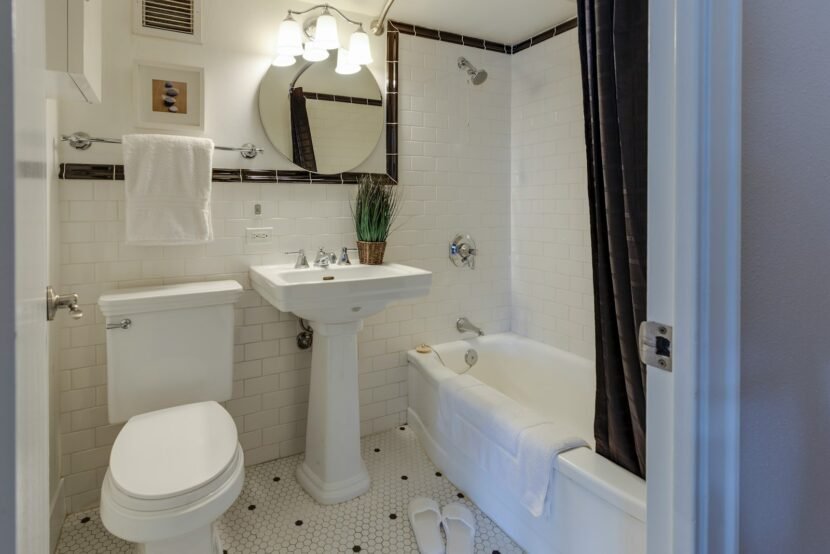
Rental bathrooms are usually the worst-designed room in the apartment. A pedestal sink with no counter, a medicine cabinet the size of a paperback, one towel bar, and lighting that appears to have been chosen to make people feel bad about themselves.
You cannot renovate it. You probably cannot drill into the tile. And you are likely leaving within a year or two, so spending real money on it makes no sense.
The good news is that bathrooms are small, which means small money goes unusually far. Everything below is removable, damage-free and comes with you when you move.
Diagnose Before You Buy
Rental bathrooms fail in a few predictable ways, and knowing which one you have prevents buying the wrong solution.
- No storage at all. Pedestal sink, no cabinet. The most common and the most solvable.
- No counter. Storage exists but there is nowhere to put things down while using them.
- Dated but functional surfaces. Beige tile, almond fixtures, a laminate vanity from a previous decade.
- Bad light. A single overhead fixture, usually cool-white, usually behind you.
- No ventilation. No fan or a fan that does nothing. This one is not cosmetic and needs handling first.
Most rental bathrooms have three of the five. Work in that order — ventilation, then storage, then light, then surfaces — because the last two do not matter if the first three are wrong.
Ventilation First, Briefly
Not decorative, but it determines whether anything else survives.
If there is no extractor fan or it is ineffective, moisture will find the grout, the ceiling and anything organic. Open the window during and after showering where there is one. Where there is not, a small plug-in fan running during and for twenty minutes after a shower does most of the job. Squeegee the shower walls — it takes fifteen seconds and removes most of the water that would otherwise become a mould problem.
Existing mould is the landlord’s responsibility in most jurisdictions, and worth reporting in writing rather than painting over. It comes back.
Storage: the Actual Problem
Rental bathrooms have surfaces and no volume. There are four unused zones in almost every one.
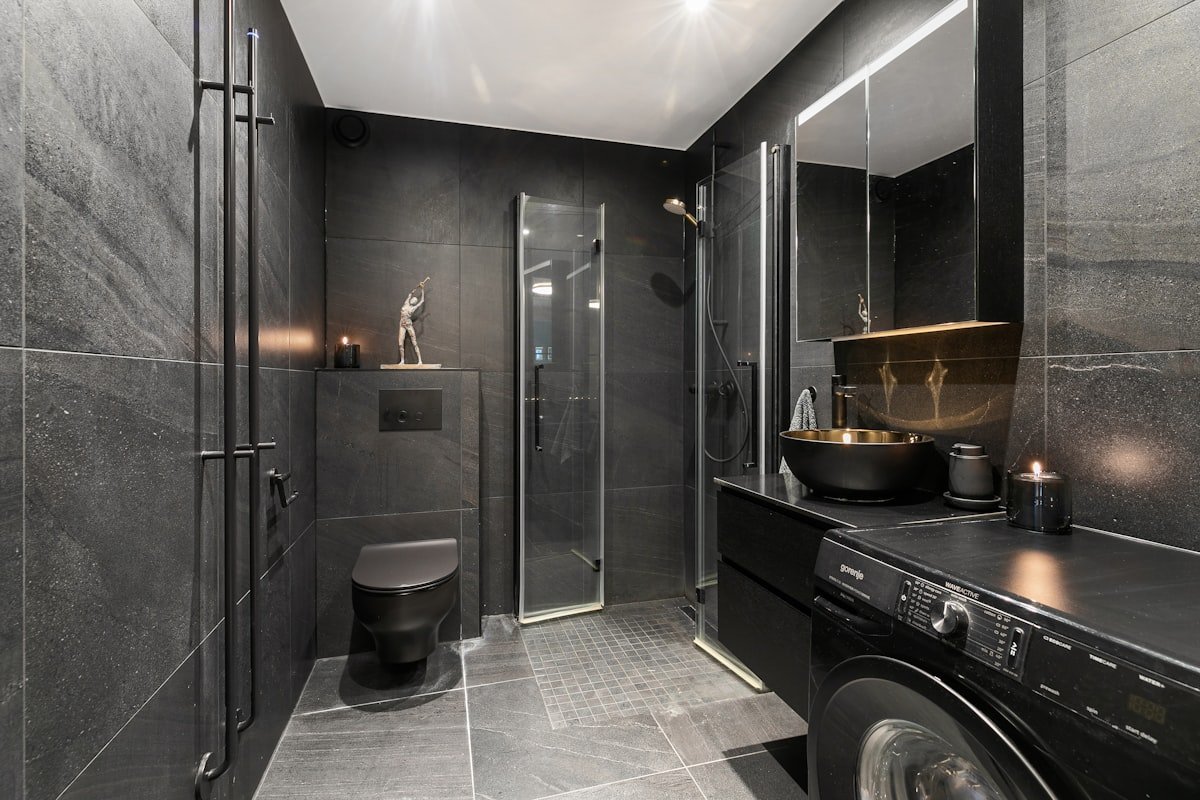
Above the toilet
The largest unused vertical space in the room. Two options:
An over-the-toilet shelf unit — freestanding, straddles the cistern, $40 to $70. Three or four shelves of genuine storage with no fixings. Look for one with at least one closed section or add fabric bins, because open shelving in a bathroom just displays your clutter at eye level.
A tension-mounted pole shelf — floor-to-ceiling, no wall contact at all. Better in very small bathrooms and good where you cannot risk any wall marks.
Under the sink
If you have a pedestal sink, the space underneath is dead. A pedestal sink skirt — fabric attached with adhesive velcro around the basin rim — hides a surprising amount of storage underneath for around $20. Not to everyone’s taste, but the capacity gain is real.
If you have a vanity cabinet, the problem is usually the plumbing eating the middle of it. U-shaped under-sink organisers are built around the pipe and roughly double usable capacity for $25 to $35. Stacking drawers beat shelves here, because you can reach the back.
Inside the shower
Suction caddies fall down. This is universal and not your fault — suction fails on textured tile and in temperature swings.
What works instead: a tension-rod corner caddy floor-to-ceiling in the corner of the tub, or a caddy that hangs over the shower head. Both are stable, both hold real weight, neither depends on suction.
The door
Every bathroom has one and almost nobody uses it. An over-door rack holds towels, robes or a shoe organiser repurposed for bottles and tools. $15 to $25, no fixings.
The wall behind the door
Usually completely empty. Adhesive hooks at two heights give you towel and robe capacity that does not compete with anything else. Use hooks rather than a rail — hooks take less depth and towels dry better on them.
Surface Fixes That Come Back Off
Everything here reverses. Test each on a hidden patch first, and photograph the bathroom at move-in so pre-existing damage is documented.
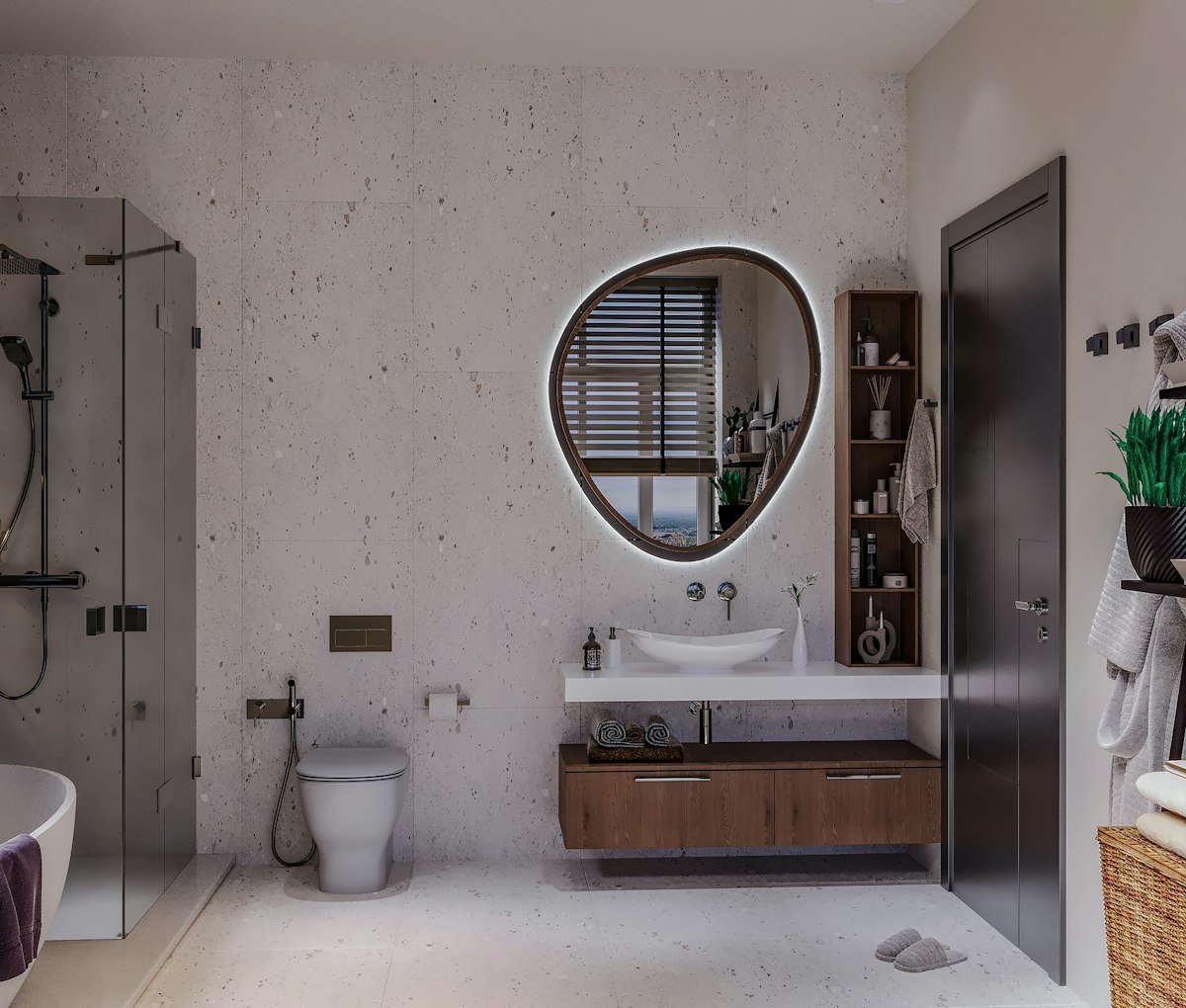
The shower curtain is the biggest single change
The clear vinyl liner that came with the apartment is doing more damage to the room than anything else in it. A fabric curtain in a solid colour or a simple texture costs about $20 and changes the room more than any other twenty dollars available.
Two details that matter. Hang it high — a tension rod near the ceiling rather than just above the tub makes the whole room read taller. And keep a separate plastic liner inside the fabric curtain, which keeps the fabric dry and means it lasts.
Peel-and-stick tile
Genuinely good now, and the best available fix for dated tile or a bare wall behind the sink. $2 to $5 a square foot.
Where it works: backsplash areas, the wall behind a vanity, an accent strip. Where it fails: inside the shower or anywhere with direct water contact, and on textured or heavily grouted surfaces where it will not adhere flat.
Clean the surface with isopropyl alcohol first, not soap, and start from the most visible corner so cut edges end up where nobody looks.
Vinyl floor tile
Peel-and-stick vinyl over an ugly floor is $1 to $3 a square foot and takes an afternoon. For a truly damage-free version, lay it over a sheet of thin underlay rather than directly on the existing floor — it lifts out completely at move-out.
Alternatively, a large washable bath mat covers most of a small bathroom floor for $30 and requires no commitment at all.
Contact paper on the vanity
Works in small doses. A dated vanity front or a bad countertop can be wrapped for around $20. Be realistic: it looks convincing on flat panels and unconvincing on anything with a profile or a rounded edge, and seams show at close range in bright light.
What not to attempt
Do not paint tile. Tile paint fails in wet areas, chips at the edges, and you will be charged for it. Do not replace fixtures unless you keep the originals and can reinstall them. Do not caulk over existing mould — it grows through.
Lighting and Mirrors
Bathroom lighting is bad in nearly every rental for the same reason: one fixture, overhead, cool-toned, positioned behind whoever is at the mirror.
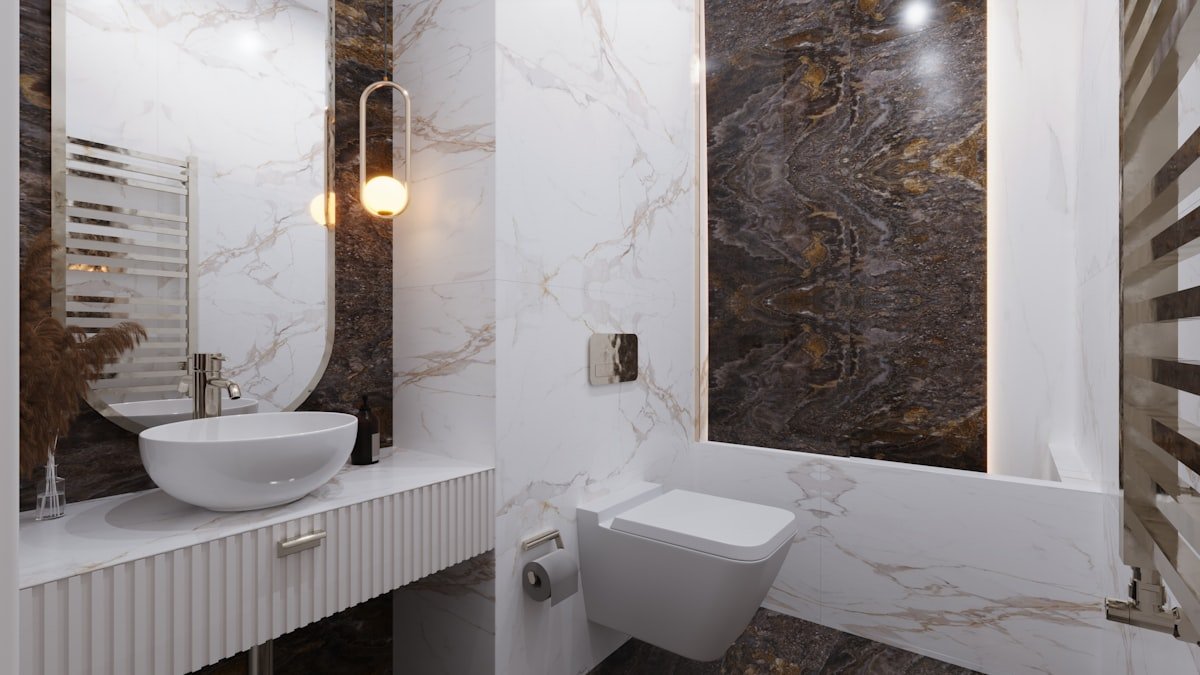
Change the bulb first
Swap to 2700K to 3000K. Bathrooms are the one room where slightly higher than 2700K is defensible, because you need to actually see what you are doing. Anything at 4000K and up is the light of a hospital corridor and makes every surface look worse.
Keep the original bulbs in a bag for move-out.
Add light at face height
Overhead light casts shadows downward, which is why everyone looks tired in rental bathrooms. Any light at face level fixes it. Options that need no wiring: battery LED sconces with adhesive mounting, a plug-in vanity light if there is an outlet, or stick-on puck lights either side of the mirror.
Around $25 to $40 and it makes a bigger difference to daily experience than anything else in this article.
The mirror
Rental mirrors are usually small, frameless and slightly wrong. Two fixes:
Frame the existing one. Adhesive mirror-frame kits, or plain trim cut to size and attached with removable adhesive, for $25 to $50. Turns a builder-grade mirror into something intentional.
Lean a larger one. If there is any counter or shelf, a larger mirror leaned in front of the existing one reads better and adds reflected light. Zero fixings.
The Cheap Details That Do the Most
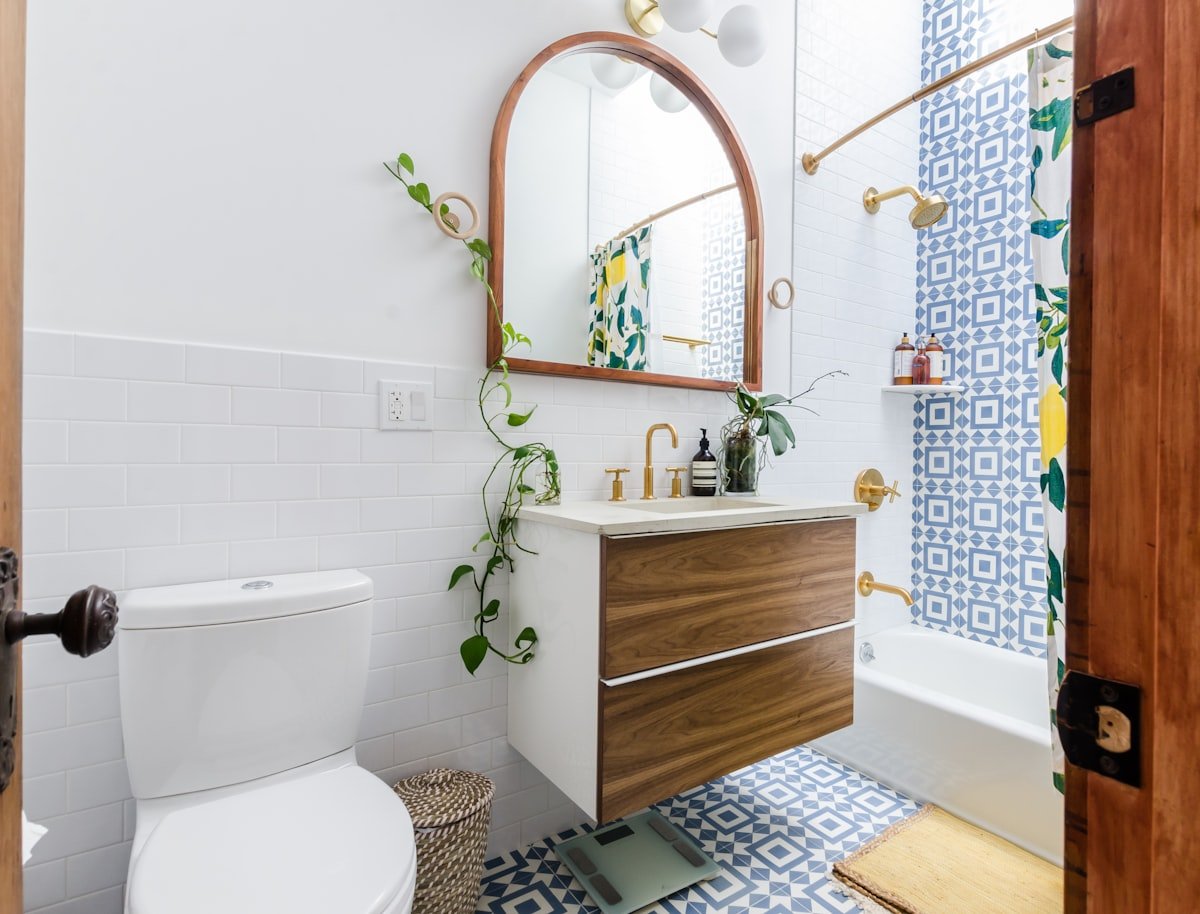
Decant everything
The single most visible low-cost change in a bathroom. Shampoo, conditioner and body wash in three matching pump bottles removes an entire wall of competing brand labels. A set is around $15.
Do the same on the counter — soap, lotion, cotton buds in matching containers rather than their original packaging. This is most of what makes styled bathrooms look styled.
Towels in one colour
Four towels in a single colour, $25 to $40. Mismatched towels are the clearest signal of a temporary space, and matching ones are the cheapest way to look organised.
Roll them in a basket if there is nowhere to hang more than two. It reads as deliberate and takes less linear space than folding.
Baskets, all the same
Three or four matching baskets in one material — seagrass, wire, canvas — turn open shelving from clutter display into storage. Around $10 each. Matching matters more than material.
One plant that tolerates a bathroom
Pothos, snake plant or a fern will survive most bathrooms, including windowless ones for a while. A single plant does a lot to make a hard-surfaced room feel less clinical, for around $12.
Small Bathroom Specifics
Under 40 square feet, a few things change:
- Hang the shower curtain at ceiling height and choose a light colour. A dark curtain in a small bathroom closes the room down.
- Use a clear or fabric curtain rather than a heavy one to keep the tub area visually part of the room.
- Go vertical everywhere — floor-to-ceiling tension shelving in a corner uses space that is otherwise entirely wasted.
- One larger mirror beats two small ones. Reflected light is functionally free extra space.
- Wall-mount what you can. A toothbrush holder, soap dispenser and cup mounted on adhesive fixings clears the entire sink edge, which in a small bathroom is most of your usable surface.
Sharing a Bathroom
Shared rental bathrooms fail on volume rather than tidiness — four people’s products in a space designed for one.
One container each. A caddy or basket per person, taken in and out. This is the only system that reliably works in a shared bathroom, because it removes the question of whose things are cluttering the shelf.
Shared items get a shared spot. Toilet roll, cleaning supplies, hand soap. Agreed and labelled if necessary.
One hook per person, at different heights. Solves the towel problem, which is otherwise the main source of shared-bathroom friction.
A door-hung caddy per person if there is genuinely no shelf space, which in student housing there often is not.
What It Costs
| Item | Cost | Priority |
|---|---|---|
| Fabric shower curtain + liner | $28 | Do this first |
| Warm bulbs (2700–3000K) | $8 | Do this first |
| Over-toilet shelf unit | $55 | High |
| Under-sink U-organiser | $30 | High |
| Tension corner shower caddy | $25 | High |
| Matching towels (x4) | $32 | Medium |
| Pump bottle set | $15 | Medium |
| Adhesive hooks (x4) | $12 | Medium |
| Face-height lighting | $32 | Medium |
| Storage baskets (x4) | $40 | Medium |
| Over-door rack | $20 | Lower |
| Mirror frame kit | $35 | Lower |
| Peel-and-stick backsplash | $30 | Lower |
| Bath mat | $25 | Lower |
| Plant | $12 | Lower |
| Total | $399 |
The first five rows — $146 — cover ventilation-adjacent basics, all the storage and the two changes people notice most. The rest is optional refinement.
Protecting the Deposit
- Photograph everything at move-in, including existing grout staining, chips and any mould. Date-stamped.
- Test every adhesive product on a hidden patch and leave it 48 hours before committing.
- Keep original fixtures, bulbs and hardware in a labelled bag.
- Remove adhesive strips by pulling the tab slowly straight down, never outward.
- Report leaks and mould in writing when you find them, not when you leave.
- Peel-and-stick products remove more cleanly with gentle heat from a hairdryer.
Frequently Asked Questions
How do I add storage to a bathroom with no cabinet?
An over-the-toilet shelf unit is the highest-capacity option and needs no fixings. Add a tension-rod corner caddy in the shower, an over-door rack, and adhesive hooks on the wall behind the door. Those four use space that is otherwise entirely wasted and together cost under $120.
How can I make a rental bathroom look better without renovating?
Replace the vinyl shower curtain with a fabric one hung at ceiling height, swap to warm bulbs, add light at face level, decant products into matching bottles, and use towels in a single colour. Those five changes cost around $110 and are fully reversible.
Does peel-and-stick tile work in bathrooms?
Yes for backsplashes and walls away from direct water. No inside showers or tub surrounds, where water gets behind the adhesive. Clean with isopropyl alcohol first and avoid textured or heavily grouted surfaces, which prevent a flat bond.
Why does my shower caddy keep falling down?
Suction cups fail on textured tile and in the temperature and humidity swings of a shower. Use a floor-to-ceiling tension pole caddy or one that hangs over the shower head instead — neither relies on suction and both hold considerably more weight.
How do I organise a shared bathroom?
Give each person one portable caddy for their own products, taken in and out rather than left on shelves. Add one hook per person at different heights and designate a single shared spot for communal items. Shared bathrooms fail on volume, not tidiness.
How do I stop mould in a bathroom with no fan?
Open a window during and after showering, or run a plug-in fan for twenty minutes afterward. Squeegee the shower walls after use. Report existing mould to your landlord in writing rather than painting or caulking over it, since it grows back through both.
Can I paint bathroom tile in a rental?
Not advisable. Tile paint fails in wet areas, chips at edges, and is very difficult to reverse — most landlords will charge for it. Peel-and-stick tile over the same area is removable and looks better.
The Short Version
Ventilation first, because everything else depends on it. Then the four unused zones: above the toilet, under the sink, the shower corner, the back of the door. Then a fabric curtain hung high, warm bulbs, and light at face height. Then decant everything and match the towels.
Roughly $150 covers the changes that matter. The rest is refinement, and none of it needs a landlord’s permission.