The idea that a small living room demands design compromises is simply not true. What it demands is more deliberate decisions. These small space living room ideas rest on one principle: every piece of furniture, every color, and every object on a surface has to earn its place. Done well, the result feels refined rather than limited. Below are 9 practical, renter-friendly strategies with measurements, materials, and rough price ranges.
1. Choose Multi-Functional Furniture
In a small living room, a piece that does only one job is a luxury. Swap a standard coffee table for a storage ottoman about 30 to 36 inches wide and 16 to 18 inches high; it holds blankets, seats guests, and takes a tray for drinks. Add a nesting pair of side tables that tuck away, and use a console table 12 to 16 inches deep as both a display surface and a laptop desk. Storage ottomans usually cost $60 to $180, and nesting tables $40 to $150, depending on material.
2. Right-Size the Sofa
An oversized sofa is the most common small-room mistake. Measure the wall, tape the footprint on the floor, and leave 30 to 36 inches of walkway on every side people pass. A loveseat of 60 to 72 inches or a compact three-seater often beats a standard 84-inch sofa, and slim arms can win back 4 to 6 inches. Pick raised legs of 6 to 8 inches so you can see floor underneath, which makes the room read as larger. Apartment-size sofas commonly run $300 to $900. Our guide on how to arrange furniture in a small living room shows layouts that work.
3. Go Vertical With Tall Shelving
Floor-to-ceiling storage keeps the floor clear and pulls the eye upward. Owners can build shelving into a wall, but renters get a similar effect from a freestanding bookcase 72 to 84 inches tall, usually $60 to $200. Always secure tall pieces with an anti-tip strap, which most rentals allow because it leaves only small screw holes. Fill about two thirds of the shelves and leave the rest open, mixing books laid flat and standing, baskets for hidden clutter, and one or two plants so the unit feels styled rather than stuffed.
4. Use a Tonal Color Scheme
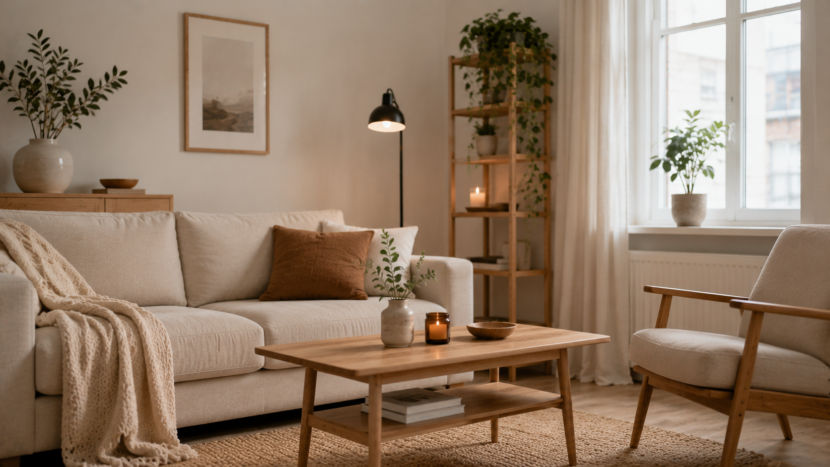
Light colors help, but a tonal scheme helps more. When walls, the sofa, and the curtains sit in the same or neighboring tones, the eye reads one calm space instead of several boxes. A cream sofa against warm white walls with oatmeal curtains looks airy, while the same sofa against dark walls with bright curtains looks busy and smaller. Limit yourself to three colors, and save contrast for small accents such as two cushions, a throw, and a piece of art. Choose paint with a high light reflectance value, often listed on the can, for walls that bounce light around.
5. Hang a Large Mirror Opposite the Window
A large mirror in a small living room works like architecture, not decoration. Place a mirror about 30 by 60 inches or bigger across from the main window so it doubles the daylight and suggests space beyond the wall. Leaning floor mirrors cost roughly $60 to $200 and need no drilling, but use a wall strap or furniture anchor so they cannot tip. Avoid reflecting clutter or a bright TV screen; aim the reflection at a plant, a window, or a clean stretch of wall.
6. Layer Lighting at Three Heights
One overhead light flattens a small room. Add a floor lamp in a corner, a table lamp on the side table or console, and a plug-in wall sconce to leave surfaces free. Choose warm bulbs around 2700K so the room feels cozy at night. Lamps usually cost $20 to $80 each, and plug-in sconces about $25 to $70. For the full approach, see our small room lighting ideas, and for efficient bulb choices the U.S. Department of Energy LED lighting guide explains labels and color temperature.
7. Hang Curtains High and Wide
Mount the rod 4 to 6 inches above the window frame, or close to the ceiling, and extend it 8 to 12 inches past each side. Panels that hang from there make windows look taller and wider and let the whole glass area show. Choose floor-length linen-look panels in a color close to the wall, usually $25 to $90 per panel. Our curtain ideas for small rooms covers rods, lengths, and sheer layering in more detail.
8. Pick One Rug That Anchors the Seating
Several small rugs chop a small room into pieces. Use one rug large enough that at least the front legs of the sofa and chairs sit on it, often 5 by 8 feet, or 6 by 9 feet in a bigger room. Flat-weave cotton, wool blends, and low-pile polypropylene all work, and prices commonly range from $80 to $300. A neutral or softly patterned rug close to the sofa color keeps the tonal look going. Add a non-slip pad ($15 to $40) so the edges lie flat.
9. Edit Surfaces and Add One Statement Piece
Clutter shrinks a room faster than any furniture choice. Keep each surface to about three objects of different heights, such as a lamp, a small plant, and a tray with a candle. Then pick a single statement element, like an oversized piece of art 30 by 40 inches or larger, a sculptural chair, or a bold lamp. One strong piece gives the eye a place to rest, and everything else can stay quiet. Store the rest in a lidded basket or inside the ottoman so it rotates in with the seasons.
Small Living Room on a Budget: Where to Spend and Save
If you have a limited budget, spend on the pieces you use every day, such as the sofa, and save on shelving, mirrors, and decor, which are easy to find secondhand. A realistic starter plan is $300 to $900 for the sofa, $60 to $150 for lighting, $80 to $300 for a rug, and $50 to $200 for a mirror, with prices varying by region and season. For tighter budgets, our cozy apartment living room ideas under $100 and 20 tricks to make a small living room feel bigger are good places to start.
Four Small Living Room Mistakes to Avoid
Four mistakes show up again and again. First, pushing every piece against the walls; floating the sofa a few inches off the wall or angling one chair creates a more intentional layout and better traffic flow. Second, buying furniture without measuring doorways, since a 90-inch sofa that cannot clear a 30-inch door is an expensive lesson. Third, hanging art too high; the center of a piece should sit about 57 inches from the floor. Fourth, filling shelves and tables with many tiny objects, because fewer, larger items look calmer. Fix these four and the nine ideas above will do far more for the room.
Will it actually fit?
Use our free furniture planner — enter your room size and see exactly which pieces fit, with layout tips for your space.
Small Space Living Room FAQ
How do I make a small living room look bigger?
Use a tonal color scheme, hang curtains high and wide, add a large mirror opposite the window, and choose furniture with raised legs. Keep walkways 30 to 36 inches wide, layer warm lighting, and limit surfaces to about three objects. Together these changes make a room feel taller, lighter, and less crowded.
What color is best for a small living room?
Warm whites, cream, soft greige, and pale sage all reflect light well. A tonal palette, where walls, sofa, and curtains share the same color family, makes the room feel larger than strong contrast does. Add depth with two or three accent items such as cushions, a throw, and artwork rather than painting dark walls.
What size sofa fits a small living room?
Aim for a loveseat of 60 to 72 inches or a compact three-seater around 72 to 78 inches, with slim arms and raised legs. Always tape the footprint on the floor first and keep 30 to 36 inches of walkway on the sides people pass through, so the room stays comfortable to move around in.
Can I style a small living room without drilling?
Yes. Use leaning mirrors, freestanding bookcases secured with anti-tip straps, floor and table lamps, plug-in sconces, and tension or adhesive-based curtain solutions where your lease allows. Layered textiles and one large rug add warmth without touching the walls, and everything can move with you when your lease ends.
Final Thoughts on Small Space Living Room Ideas
A small living room rewards careful choices. Start with the sofa size and a single rug, add lighting at three heights, then edit your surfaces until each object feels deliberate. Save the ideas you like and come back to HomeDecoHarmony for more small-space guides.