Most advice about bedroom decor ideas for better sleep focuses on how the room looks. This guide focuses on how the room makes you feel when you lie down at night. A bedroom’s primary job is not to be photographed. It is to help you fall asleep, stay asleep and recover from the demands of your day. When it does that job well, it looks beautiful as a natural consequence.
The ideas below are grounded in sleep research and the psychology of rest environments. They are also practical, affordable and almost all renter-friendly, so you can improve your sleep without painting, drilling or renovating.
Darkness: The Foundation of Good Sleep
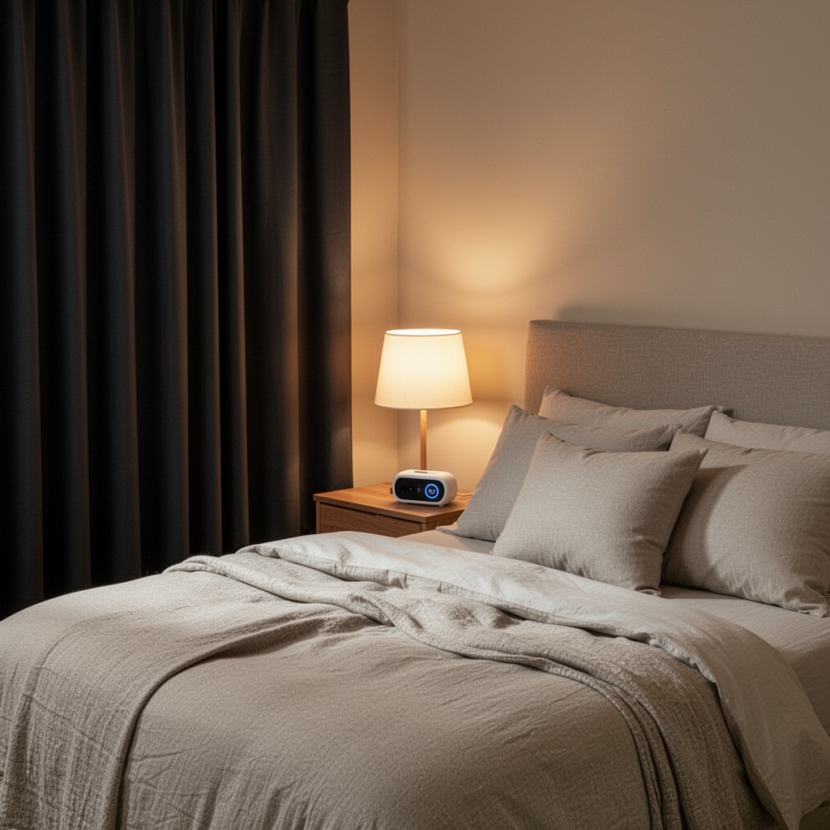
Light is the most powerful signal your brain receives about whether it is time to sleep or stay awake. A bedroom that is not dark enough for your personal light sensitivity will always produce worse sleep than one that is. Blackout curtains, or blackout lining added to curtains you already own, are the single most impactful sleep-supporting decor change available.
For the best result, mount the rod higher and wider than the window frame, ideally 10 to 15 cm above and 15 to 20 cm beyond each side, so the fabric overlaps the wall and blocks the light gaps that leak around the edges. Look for a triple-weave or thermal-backed fabric. Ready-made blackout panels usually cost somewhere between $25 and $80 per pair, and clip-on or tension-rod options avoid any drilling. Our guide to curtain ideas for small rooms has styling options that still make the window look generous.
Eye Masks as a Backup
If blackout curtains are not an option in your rental, a quality silk or contoured eye mask achieves much the same result for roughly $10 to $30. Keep it on your bedside table as a deliberate part of your sleep setup rather than something you occasionally find in a drawer. Cover small standby lights on chargers and electronics with a piece of black electrical tape.
If Your Room Has Very Little Daylight
Darkness at night is only half of the picture. Your body clock also needs bright light by day. If your room is naturally dim, take a look at our tips for a small bedroom with no natural light to balance both ends of the day.
Temperature Control Through Textiles
Sleep research consistently identifies a slightly cool room as best for sleep quality. The Sleep Foundation suggests roughly 15 to 19 degrees Celsius (60 to 67 degrees Fahrenheit) for most adults, and you can read their full guidance at sleepfoundation.org. Use textiles to manage warmth rather than turning the heating up.
Layering is the key. A breathable base such as a cotton or linen duvet cover, a mid-weight duvet and a wool or knit throw folded at the foot of the bed lets you add or remove warmth through the night without fully waking. Linen and percale cotton sleep cooler than flannel or microfibre. If you share a bed with someone who runs hotter or colder, use two separate duvets or blankets rather than compromising on one.
A mattress topper is another worthwhile layer. Wool and latex toppers regulate temperature better than memory foam, which tends to trap heat. Expect to pay anywhere from $40 to $150 depending on size and material.
Colour and Your Brain at Bedtime
Cool blues and greens are associated with calm and a lower sense of arousal. Warm neutrals such as beige, cream, oatmeal and soft grey are broadly linked with relaxation. Bright colours, strong contrasts and highly saturated tones tend to stimulate rather than soothe. For a bedroom designed around sleep, stay at the muted, warm and soft end of the spectrum.
You do not need to repaint. Colour can come through bedding, curtains, a rug, a headboard cover or a large piece of art. A sage green duvet cover with oatmeal pillowcases and a warm white throw delivers the effect for about $60 to $130 in total. Keep to two or three tones, and let texture create interest instead of pattern. For palettes that feel grounded, see our neutral earthy bedroom ideas.
Bedding and Bedside Lighting
Good bedding is the most direct contact you have with your bedroom, so it deserves the largest share of your budget. Choose natural, breathable fibres, a pillow that matches your sleeping position, and a fitted sheet that stays put. Wash bedding weekly in warm water, and the bed will feel inviting every night.
Lighting needs the same care. In the last hour before bed, use warm, low light rather than overhead brightness. Look for bulbs rated around 2200K to 2700K, and place two small lamps at bed height rather than relying on a ceiling fitting. Smart bulbs or plug-in dimmers, usually $10 to $25, let you lower the light gradually, which tells your brain that the day is ending.
Remove Technology From the Sleep Environment
The bedroom should not contain anything your brain associates with stimulation, productivity or obligation. A television, a desk covered in work and a phone charging beside your pillow all communicate that this room requires alertness. Move what you can. What you cannot move, cover or turn face down at night.
Charge your phone across the room, and use a simple analogue alarm clock (often $10 to $20) so you are not tempted to check notifications. If you must work in the bedroom because of space, a folding screen or a closed cabinet can hide the desk at night. The idea is to give the bed one job.
Sound and Silence
A bedroom that is too quiet can be as disruptive to sleep as one that is too noisy for light sleepers, because every small sound stands out. A white noise machine, a fan or a sleep-sounds app can mask disruptive external noise and create a consistent acoustic environment that the brain learns to associate with sleep. Entry-level machines usually cost $20 to $50.
Soft furnishings also absorb sound. Heavy curtains, a large rug, upholstered headboards and a bookshelf against a shared wall all reduce echo and outside noise. If you share a wall with neighbours, placing the bed on the opposite side of the room can make a noticeable difference.
Scent as a Sleep Trigger
The olfactory system has a direct connection to the limbic system, which governs emotion and memory. A consistent scent used only in the bedroom at sleep time can become a powerful trigger over time. Lavender is the most researched: studies suggest it can reduce heart rate and blood pressure, and some people fall asleep faster with it.
A lavender pillow spray used consistently at bedtime is inexpensive, usually $8 to $20. A lavender sachet inside the pillowcase or a small diffuser with lavender oil achieves the same result. Use it only at bedtime so the association stays strong, and patch-test anything you put near your skin.
Clutter, Storage and Layout
Visual clutter keeps the brain subtly switched on, because every unfinished pile registers as a task. Aim for clear surfaces on the nightstand and dresser, with a tray for the few items you need nightly, such as a glass of water, a book and hand cream. Under-bed storage boxes and a closed wardrobe handle the rest. Our guide to bedroom storage ideas that hide clutter shows renter-friendly options.
Layout matters too. Where possible, place the bed so you can see the door without being directly in line with it, keep walkways clear, and avoid sleeping under a heavy shelf or bright window. A calm, symmetrical arrangement with a nightstand on each side feels settled and balanced.
For a complete softer look that pulls these ideas together, browse cozy bedroom sanctuary ideas on a budget and cozy bedroom ideas for deep sleep.
Frequently Asked Questions
What is the best bedroom colour for sleep?
Muted blues, sage greens and warm neutrals such as cream, beige and soft grey are the most calming choices for most people. They have low saturation, so they do not stimulate the eye. Avoid bright reds, intense yellows and high-contrast patterns near the bed. You can introduce colour through bedding and textiles without repainting.
What temperature should a bedroom be for good sleep?
Most sleep experts recommend a cool bedroom, around 15 to 19 degrees Celsius (60 to 67 degrees Fahrenheit). Your ideal may vary slightly. Rather than adjusting the thermostat, layer breathable bedding, such as a cotton or linen duvet cover with a removable wool throw, so you can regulate your temperature during the night.
Can I improve my bedroom for sleep in a rental?
Yes. Tension-rod blackout curtains, a rug, bedding, lamps, a white noise machine and scent products all work without permanent changes. Peel-and-stick options and removable adhesive strips cover most other needs. These changes take your deposit into account, and they move with you when your lease ends.
What is the first thing I should change?
Start with light control. Blackout curtains or a good eye mask usually deliver the largest improvement for the lowest cost. Next, reduce clutter and technology around the bed, then upgrade your bedding. Make one change at a time for a week or two so you can tell what actually helps.
Final Thoughts
A bedroom built for sleep is dark, cool, quiet, softly coloured and uncluttered. None of that requires a renovation. Choose two or three of these changes this week, give each a fair trial, and keep what works. If you want more ideas, the Centers for Disease Control and Prevention also publishes sleep hygiene tips at cdc.gov/sleep.