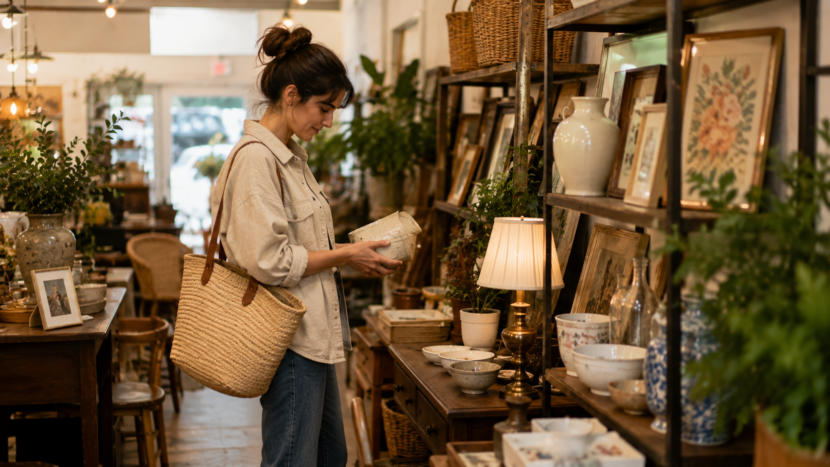
Thrift stores and Facebook Marketplace are where the best home decor lives. Not the curated, overpriced “vintage” pieces — the actual good stuff that somebody bought for full price, used for two years, and listed for $15 because they’re moving next weekend.
We’ve furnished entire rooms through thrift stores and Marketplace and learned what to buy, what to avoid, what to inspect before loading into your car, and what you can fix for under $20 that would cost $200 new. This is the guide we wish we’d had before our first haul.
Quick promise: We’ll tell you what’s genuinely worth buying secondhand, what to always buy new, and the three things to check on every piece before you hand over cash.
What to Always Buy Secondhand
Solid wood furniture
Solid wood is the single best secondhand category. A $400 solid oak dresser from 1985 is structurally better than a $400 particle-board dresser from 2024. It refinishes, it repaints, it survives moves. Look for dovetail joints in drawers (finger-like interlocking cuts at the corners) rather than stapled cardboard backs — that’s the difference between furniture that lasts 50 years and furniture that lasts 5.
When you find solid wood pieces that need refreshing, Rust-Oleum Chalked Ultra Matte Paint transforms a dated brown dresser into a piece that looks like it came from a boutique home store. Two coats, no primer needed on most wood surfaces.
Mirrors
Mirrors are the best thrift store find in existence. A large mirror that would cost $150-$300 new routinely shows up at Goodwill for $10-$30. The glass is the same. The frame can be spray-painted in 20 minutes. An ugly gold sunburst mirror becomes matte black or warm brass with one can of Rust-Oleum Metallic Spray Paint and 30 minutes of your Saturday.
Artwork and frames
The art inside thrift store frames is almost always forgettable. The frames themselves are often excellent — solid wood, interesting profiles, sizes that would cost $40+ at a frame shop. Remove the art, clean the glass, and fill with your own prints. Desenio prints and free Unsplash downloads printed at your local print shop for $3 each are indistinguishable from gallery pieces in a good frame.
Ceramic and glass vessels
Vases, bowls, pitchers, and decorative ceramics at thrift stores are often genuinely good pieces from brands like West Elm, Pottery Barn, and Crate and Barrel that someone donated after a style refresh. Check the bottom for maker’s marks. A $4 Goodwill vase from a recognizable brand is a $4 vase that would retail for $45.
Lamps (bases only)
Lamp bases are another category where secondhand wins consistently. The base is the expensive part. An outdated brass lamp base becomes current with a can of matte black spray paint and a new shade. Lamp shades from thrift stores are hit or miss — inspect for stains, warping, and yellowing. The base is worth buying; the shade usually isn’t.
Facebook Marketplace Specifically: What Works Best
Sofas and upholstered chairs
Facebook Marketplace is better than thrift stores for large upholstered pieces because you can see detailed photos before committing and negotiate before pickup. A $600 sofa from a family who’s upgrading is often in better condition than a floor model sold for the same price new.
What to inspect before pickup: Smell it first (pet odors and smoke don’t fully come out). Check the seat cushions for compression — sit on it and see if it springs back. Look under the cushions for staining. Check the frame by trying to wobble it — solid frames don’t flex.
A fabric sofa that smells faintly musty can often be refreshed with Febreze Fabric Refresher Heavy Duty and a full day of ventilation. Pet hair comes off most fabrics with a ChomChom roller — the best lint roller made, worth owning regardless.
Dining tables
Solid wood dining tables on Marketplace are routinely listed for $50-$150 that would cost $400-$800 new. Surface scratches on wood tables sand out in an afternoon. A Minwax Wood Finish Stain in the right tone and the table looks new. This is one of the highest-ROI Marketplace categories for apartments.
Bookshelves and storage units
IKEA KALLAX, BILLY, and HEMNES units appear on Marketplace constantly from people who are moving. These are assembled-once pieces that hold up fine to a second home. Paying $30-$60 for a unit that costs $120-$200 new is one of the most reliable Marketplace wins, especially in cities with high apartment turnover.
The Three-Check Rule Before Every Purchase
Before you hand over cash or load anything into your car, run these three checks on every secondhand piece:
- Smell it. Pet urine, cigarette smoke, and mold are almost impossible to fully remove from upholstered or porous pieces. If you smell any of these, walk away regardless of price.
- Check the structure. Wobble it, open every drawer, sit on it. Structural problems don’t get better. Surface problems almost always do.
- Measure before you go. The number one Marketplace mistake is falling in love with a piece that doesn’t fit through your door or into your space. Bring a tape measure to every pickup.
What to Always Buy New
- Mattresses — no exceptions, no matter the price or condition claimed
- Upholstered pieces with visible staining — stains through to the foam don’t come out
- Anything with visible mold or water damage — it goes deeper than the surface
- Office chairs — the ergonomic components wear out and can’t be assessed secondhand
- Pillows and cushion inserts — replace these even in otherwise great secondhand pieces
Comparison: Thrift Store vs. Facebook Marketplace
| Category | Best source | Why | Typical savings vs. new |
|---|---|---|---|
| Solid wood furniture | Either | Inspectable in person | 60-80% |
| Mirrors | Thrift store | Lower price, instant find | 70-90% |
| Sofas / chairs | Marketplace | Photos + negotiation before commit | 40-70% |
| Dining tables | Marketplace | Larger pieces, better condition disclosure | 50-75% |
| Artwork / frames | Thrift store | Volume browsing finds gems | 80-95% |
| IKEA units | Marketplace | Consistent quality, exact model searchable | 40-60% |
| Ceramics / vases | Thrift store | Brand pieces donated regularly | 70-90% |
Worth It vs. Skip It
✅ Worth It Secondhand
- Any solid wood piece in structurally sound condition — surface issues are fixable
- Large mirrors — same glass, paintable frame, fraction of the price
- Thrift store frames — replace the art, keep the frame
- IKEA units on Marketplace — known quality, predictable assembly
- Ceramic and glass vessels from recognizable brands — check the base for marks
❌ Skip It Secondhand
- Anything with pet odor or smoke smell — not fixable in soft furnishings
- Mattresses — always buy new, no exceptions
- Upholstered pieces with unknown staining history — the risk isn’t worth the saving
- Flat-pack furniture that’s been assembled and disassembled more than once — the joints fail
- Wicker and rattan in poor condition — it doesn’t restore well and looks worse over time
Frequently Asked Questions
Is Facebook Marketplace safe for buying furniture?
Generally yes, with standard precautions: meet in a public place for small items, bring a friend for large pickups at someone’s home, pay cash or use PayPal Goods and Services (not Friends and Family) for any transaction over $50. Most Marketplace sellers are simply people who are moving — not scammers.
How do you make thrifted furniture look intentional?
Paint, hardware, and context. A dated dresser in the right color with new handles reads as a deliberate vintage find. A thrifted mirror with a freshly spray-painted frame looks like a design choice. The secret is committing to the refresh rather than displaying the piece in its found condition and hoping for the best.
What time of year is best for thrift store and Marketplace finds?
Late spring and early summer (May-July) is peak season in most cities, driven by end-of-lease moves. September is the second peak for the same reason. These are the best windows to find large furniture pieces in good condition at low prices, particularly in cities with large student populations.
How do you clean thrifted furniture before bringing it inside?
Hard surfaces: wipe down with a diluted white vinegar solution or Murphy Oil Soap for wood. Upholstered pieces: vacuum thoroughly, then treat with Febreze Heavy Duty and let air out for 24-48 hours before bringing inside. For any piece with unknown history, a UV light can reveal stains not visible to the naked eye.
Conclusion
The best-looking apartments we’ve been in rarely have the most expensive furniture. They have the most intentional furniture — pieces chosen for their bones, refreshed where needed, and placed where they work. Thrift stores and Facebook Marketplace are where those bones live, at prices that leave room to invest in the things that actually matter: good lighting, quality textiles, and the occasional splurge on something new that earns its place.
Start with mirrors, frames, and solid wood. Build from there.