Dining rooms are often the first room to be sacrificed when an apartment is small. There is no dedicated space, so meals happen on the sofa, on the coffee table, or while standing over the kitchen counter. This is understandable but worth pushing back against, because a dedicated eating space, even a small one, genuinely changes how you cook, how you eat, and how much you enjoy your home.
You do not need a dining room. You need a dining zone: an area of the apartment, however small, that is clearly designated for eating and that has a table, light, and at least two chairs. Here is how to create one in even the most space-constrained apartment.
The Small Apartment Dining Challenge
The difficulty is twofold: finding space for a table when floor space is limited, and making a small dining area feel like a proper room rather than an afterthought. Both challenges are solvable with the right furniture and the right styling.
Choosing the Right Table for a Small Apartment
Round Tables for Tight Spaces
A round table is almost always the best choice for a small apartment dining area. Round tables have no corners to navigate around, allow more flexible seating (you can squeeze an extra chair in more easily), and create a more intimate atmosphere for two or four people than a rectangular table of equivalent seating capacity. A round table of 80-90cm diameter seats two comfortably and four at a pinch.
Drop-Leaf and Extendable Tables
A drop-leaf table is one of the most practical dining solutions for small apartments. At its minimum size (sometimes as narrow as 30cm folded), it occupies minimal floor space. Extended, it provides a proper dining surface. The IKEA GAMLEBY drop-leaf table (£125) extends from a narrow side-table to a table that seats four. This is the kind of furniture that makes a small apartment genuinely function for both everyday living and entertaining.
Wall-Mounted Fold-Down Option
For studios under 30 square metres, a wall-mounted fold-down table (£50-100) that lives flat against the wall and folds out to a two-person dining surface is the most space-efficient dining solution available. Paired with two folding chairs that hang on the wall or store elsewhere, this creates a complete dining setup that disappears completely when not in use.
Dining Chairs for Small Spaces
Stackable Chairs
If you host occasionally, stackable chairs that store flat or stacked in a cupboard allow you to have four chairs without having four chairs visible every day. Two everyday chairs at the table, two stacked elsewhere, retrieved for guests.
Benches and Window Seats
A bench along one side of a dining table takes less visual space than two chairs, can seat more people when needed, and doubles as general seating. A bench pushed against the wall or against the kitchen island takes no floor space when the table is pushed close to it. IKEA’s SKOGSTA bench (£45) is a good budget option in solid acacia.
Folding Chairs That Look Good
Not all folding chairs look like they belong in a community hall. Wooden folding chairs in natural finish (widely available on Amazon for £20-30 each) look genuinely attractive at a dining table and store in a wardrobe or behind a door between uses. The Tolix-style metal folding chair is another option that looks deliberate and works in both modern and earthy apartment aesthetics.
Making a Small Dining Zone Feel Like a Room
A Pendant Light Above the Table
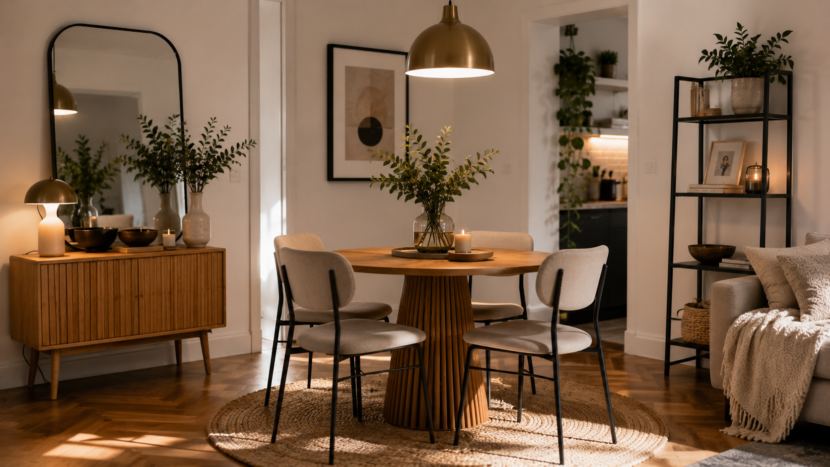
Nothing signals “dining area” as clearly as a pendant light positioned directly above the table. It creates a visual zone, casts flattering light on the table and food, and makes the dining area feel like a deliberate design decision rather than a table squeezed into a corner.
For renters who cannot install a ceiling pendant, a plug-in pendant (£25-50) uses the existing ceiling hook or a swag hook and plugs into any wall socket. A dimmer plug (£8-15) allows the light level to be lowered for evening meals. This single lighting change transforms the dining experience more than any other element.
A Small Rug Beneath the Table
A rug under the dining table defines the zone and anchors the furniture. It also protects the floor and adds warmth. The rug should extend at least 60cm beyond the table edge on all sides so that chairs remain on the rug when pulled out. For a round 80cm table with two chairs, a 150cm round rug or a 160x230cm rectangular rug works well.
Table Styling That Elevates Daily Meals
A dining table that is styled rather than bare changes how you feel about eating at it. This does not mean formal table settings. It means: a small plant or a votive candle in the centre, matching placemats or a simple cloth runner, and cutlery that you actually like using. These small things elevate the daily experience of eating at home significantly.
See our earthy home decor ideas guide for inspiration on creating warm, beautiful table vignettes.
Art and Light for the Dining Wall
The wall visible from the dining table benefits from something worth looking at during a meal. One good piece of art at eye height, a small gallery of prints, or a wall-mounted shelf with a plant and a candle. The dining wall is seen from a seated perspective, which is worth considering: hang art slightly lower than you would for standing viewing height.
Dining in an Open-Plan Apartment
In an open-plan apartment where the living room and dining area share a space, definition is achieved through lighting, rugs, and furniture arrangement. The pendant light above the dining table is the most important element: it claims that part of the ceiling and that part of the room as distinctly different from the living area. The rug reinforces the zone on the floor. The back of a sofa facing the living area and away from the dining table creates a physical boundary between the two zones.
See our guide to studio apartment zone creation for the full approach to open-plan zoning.
Final Thoughts
A dining area in a small apartment does not require a dedicated room or a large table. It requires a surface at the right height, light above it, two or more chairs, and the intention to eat there rather than on the sofa. Once you create the space, you will use it. And using it will change how much you enjoy cooking and eating at home.
Start with the light. A pendant above a table creates a dining zone from nothing. Everything else follows from that.
Will it actually fit?
Use our free furniture planner — enter your room size and see exactly which pieces fit, with layout tips for your space.